Bishop Joensen Set to Celebrate Week of Prayer for Christian Unity
by Diocese of Des Moines | January 5, 2026
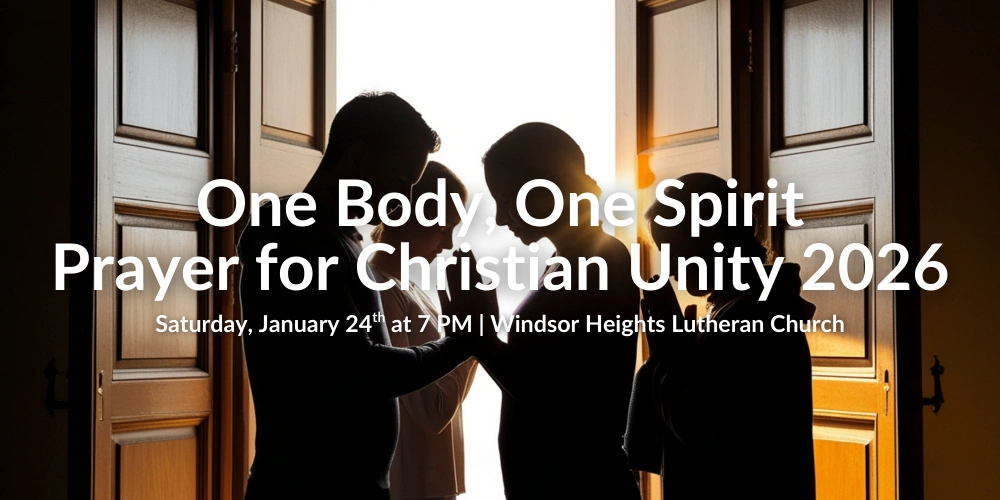
A prayer movement begun more than 110 years ago in a small Episcopal chapel 50 miles from New York City has evolved into the worldwide Week of Prayer for Christian Unity, which is Jan. 18-25.
Three bishops in the Des Moines area invite you to celebrate with them at a prayer service at 7 p.m. on Jan. 24 at Windsor Heights Lutheran Church. Joining Des Moines Bishop William Joensen, of the Catholic Diocese of Des Moines, will be Bishop Amy Current, of the Lutheran Southeastern Iowa Synod, and Bishop Betsey Monnot, of the Episcopal Diocese of Iowa.
The first prayer service was in 1908, begun by two Episcopalians, Father Paul James Wattson and Sister Lurana White, who wanted to see a reunion of the Anglican Church and the Roman Catholic Church, according to Graymoor Ecumenical and Interreligious Institute.
They converted to Catholicism, received Pope Pius X’s blessing to continue the annual weeklong prayer service, and in 1916, Pope Benedict XV extended it to the universal church.
Celebrating the Week of Prayer for Christian Unity, Des Moines Catholic Bishop William Joensen, will join Rev. Chris Olkiewicz, pastor of Windsor Heights Lutheran Church, and Rev. Kyle Carswell, of St. Timothy Episcopal Church in West Des Moines. All are invited to attend.
“Ecumenism is one of the main themes of the Second Vatican Council,” said Father John Ludwig, who has long been involved in interfaith dialogues locally. St. John Paul II had said one of his objectives, as pope, was to be a source of unity for all Christians, not just Catholics, said Father Ludwig.
The idea of Christian unity goes back to the Gospel of John, chapter 17: “I pray not only for them, but also for those who will believe in me through their word, so that they may all be one, as you, Father, are in me and I in you, that they also may be in us, that the world may believe that you sent me.”
And it’s in the Nicene Creed, written in 325, long before the Protestant Reformation of 1517: “I believe in one, holy, catholic and apostolic church.”
The desire for Christian unity continued with “Unitatis redintegratio,” a document on ecumenism from Vatican II, and with Pope Leo XIV’s recent visit to Patriarch Bartholomew to strengthen the Catholic-Orthodox bond.