Bishop’s Christ Our Life Homily: “Jesus will always be our friend”
by Diocese of Des Moines | October 6, 2026
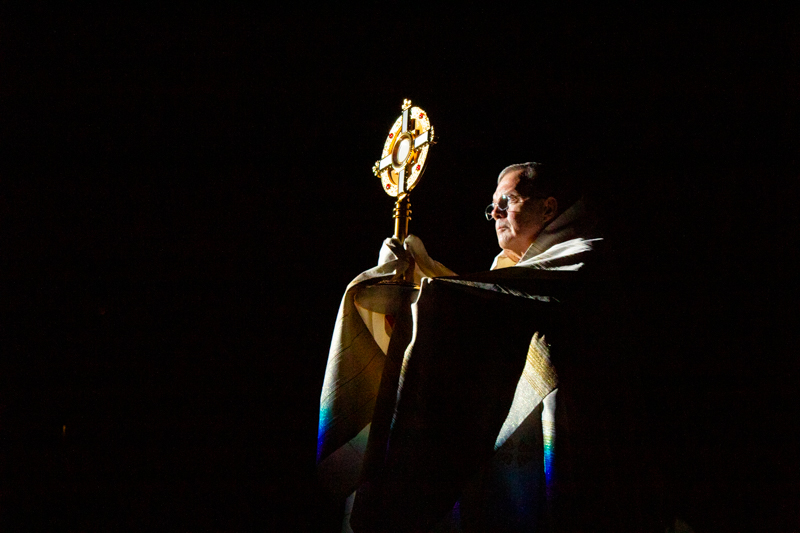
This homily was offered by Bishop William Joensen on Saturday, September 26, at the Christ Our Life conference.
It’s so good to be together for what promises to be a weekend where time takes a backseat, where God will serve us Spirit, Life, and His Son, Jesus. It’s going to be better even than a slice of Casey’s breakfast pizza.
I’ve been so looking forward to having Bishop Joseph Espaillat with us, Joseph, my brother, along with all the others. You know, I can’t get this boy from the Bronx up onto a John Deere tractor because the fields are too wet these days. But to be met with priests and deacons, seminarians, with our young people and not-so-young-people, among other things. Young people there will be a special afternoon in store for you.
But now we come together in this arena and with us virtually from wherever you may be, how many counties and countries only Marilyn Lane knows for sure, rain down your spirit upon us, O Lord, wherever we are.
This Saturday morning, the Church holds up to us not only Mary, Jesus’s mother, but Saints Cosmas and Damian, those third and fourth-century twin brothers from Syria whom God used to help touch the bodies and the souls of people looking for comfort and consolation, healing and hope. They were ultimately martyred since their charitable goodness represented a threat to the regime, and they’re looked to as patrons of physicians, pharmacists, and all sorts of health professionals. Some of you have visited the basilica dedicated in their honor along the way of the Imperial Forum in Rome, with that mosaic inscription, “Martyribus Mericinis Populo Spes Certa Salutis,” which even if you’re not a Latinist, Google Translate will tell you means roughly, “In the physician martyrs, the people have sure hope of salvation.”
But I’d like to focus on a specific feature on one of the high exterior walls of Saints Cosmas and Damian Basilica. Journalist Cullen Murphy [in his article in the August 2026 issue of The Atlantic called “How the Elite See Rome”] notes, “In the early third century C.E., an engraved map of Rome had been secured to this wall” with iron clamps. “The slabs were broken apart” during the Middle Ages to find building material, but fragments have kept resurfacing ever since, “like puzzle pieces from a couch. A thousand or so have been found, representing perhaps 10 percent of the original.”
It suggested [by Murphy] that this marble plan of the Eternal City helped guide visitors along the major streets and sites. But as the earthly power of the empire declined, the very sort of power that grew hostile to guys like Cosmas and Damian, the city’s population declined from 1 million to perhaps 20,000. There were far fewer visitors, and the depiction of the city became superfluous until Rome became a destination for religious pilgrims who far outnumbered the local inhabitants.
Okay, Joensen, why this little trip down history’s lane? I suggest that there are echoes of our first reading from Ecclesiastes author’s depiction of the trajectory of life, with the promise of youth eventually yielding to the gloom and fragmentation the world introduces in our personal story. Physical fragmentation and more importantly, social fragmentation, as individual slabs are detached from one another and scattered, so the whole of things eludes comprehension. Ecclesiastes’ mouthpiece, Qoheleth, waxes: "Rejoice, O young man, while you’re young, and let your heart be glad in the days of your youth." Trust your heart, trust your vision, and let them lead you. Oh, but be aware. Every step, every decision matters, and will either bring joy or grief in the long run. The lightness of being will dim. The weather and the matrix of relationships will turn murky or ominous. The guardians and grinders of grain will become idle as former abundance diminishes. Even those busy minding others’ business, as they peer through the shades at their next-door neighbors or scroll through social media, will grow blind. Doors will remain shut, and the music that stirred hearts, like the musicians will do for us today, will cease. Silver and gold lose their luster, and the vessels that sustain life, above all our own bodies, will be dispersed like rubble on the ash heap.
God can seem to that author of Ecclesiastes like the great recycler of life, breath, and death, infusing just enough energy to keep the cosmos spinning. Oh, can’t we simply go back to the former glory days in society or in the Church? Wasn’t life easier and better before the pandemic, or before the economic collapse of 2008, or 9/11, or the 1960s, or take your pick?
If we listen to Qoheleth, we’ll dispel our romantic illusions: Life was never ever a rose garden or a bowl of cherries. Yet there is one constant, one article of wisdom that helps things hang together and even begins to gather and rechart that map of meaning in our lives: The God of our youth is with us, not simply watching remotely in order to judge us. The Creator, who we do well to remember in our youth, is the God familiar with the various seasons and storms that beset us. God is poised not only to receive our last breath, but accompanies us with every breath we take, every note we sing, and in the punctuated silences and seeming separations that tug and tear at our own map of life.
If it all seems like vanity, don’t succumb to the temptation to throw in the towel, or to ratify the isolation by shutting our eyes and the doors of our heart for a long winter’s nap, lobbying for more access to cannabis or whatever other substances float our boat. God is with us and has not forsaken us. And in this truth is a glimmer of hope that this whole adventure of life is going somewhere, and that we’re meant to go there together. Where Ecclesiastes leaves us hanging in suspense, yearning for more sense and a world where we really feel at home, then certainly don’t imitate the folks in our Luke gospel who are readily amazed by Jesus’s words and deeds up to the point he says, Pay attention. The Son of Man is to be handed over to men.
Okay Jesus, you just lost me. But if the meaning is hidden and understanding elusive, and everyone around him cowers in fear, too afraid to engage Jesus and ask him what his words mean. Jesus, you are God’s gift to us. The only one who seems to me the longing of our hearts more precious than any silver or gold. And you’re going to hand yourself over to the bad guys? The ones who prefer that we don’t pay attention to each other and really communicate? Because then we might form a genuine community where we take note of one another and listen to one another’s story. Where we cultivate respect for what is distinct and what is similar in their story to our own, so that we can locate ourselves on a larger map, which is God’s plan and purpose for us.
Jesus, if you are to hand yourself over to others, and then I ask you questions about what that means for you, then maybe I’ll begin to ask questions about what it means for me. And to whom am I to hand myself over? Maybe even to the point that Cosmas and Damian did with their patients and their persecutors. Maybe I’ll be relieved and even rejoiced to find that my young or not so young heart is not going to lead me astray but guides me to an even greater life than I previously imagined — a life that delivers on its promise, even as the one who always accompanies me asks everything of me. And wonderfully, when I do find myself in trouble, either by my own agency or as a result of what others see fit to do to me, this constant God, this generous God, who will not spare His own Son for love of us, by some titration of grace, compassion, and personal conversion can fit in even these fragmented experiences into a map of a city that will never wane. No, not New York City, the city that never sleeps, but the city of God to which we’re all headed on pilgrimage.
When it comes to those latter kinds of experiences, where we risk posing and responding to questions, I’m reminded of the true story recounted by the late Bernard Bonawitz, a young Jewish fellow turned Catholic Christian, turned Jesuit, and then Cistercian monk and Abbott, until he contracted Lewy Body Dementia, which held him in the latter phase of his life for long periods of silence. He recalled when he was 16, in a summer course in social sciences at Columbia University in New York that was run for high school juniors and he describes an ultra-serious Jewish guy from Chicago, also 16 years old, who was in the chorus. They used to take long walks together in the evening. And one evening, the other guy said, “Let’s tell each other the worst thing we’ve ever done in our lives.”
Bonawitz said, “Why would we want to do that?”
The guy said, “Because we all live covered by seven veils. Nobody knows anyone else, and there can’t be genuine human friendship because all there is is sown and gauze and veil. There’s no true intimacy between persons. We should all get beyond that.”
Bonawitz said [as he told the story], “The guy really talked like that.”
Bonawitz reiterated [to the guy], “I don’t think I want to do that.”
“No, we’re going to do it.”
“Okay, you go first.”
So, he told Bonawitz the worst thing he’d done. And to Bonawitz, it didn’t seem like much of anything.
The guy said, “Do you still accept me?”
Bonawitz said, “Yes, I still accept you.”
“Will you still be my friend?”
“I am your friend.”
“This doesn’t change anything?”
“No!”
“Okay, your turn.”
So Bonawitz told him, and when he concluded his story about the worst thing he’d ever done, the fellow said, “I can’t be your friend anymore.”
“Excuse me?”
“Not if you did that. I couldn’t be friends with a person who’s done something like that. But I appreciate your transparency. I do wish you all the best in life.”
That’s the last time the two ever spoke, even though they ended up going to the same university for four years.
That’s our fear. Our fear of posing questions to Jesus. Our fear of responding to questions with transparency and trust — it’s the sort of fear that progressively squeezes the breath out of us and constricts the scale of our lives, prompts us to close the shutters of our minds and heart[s]. Only God can help us get beyond this blockage. Only a God who becomes man, who offers us his mercy. Who heals us and frees us to trust others and ourselves again. God won’t let Qoheleth have the last word. He hands himself over to men and women and young people like ourselves, as he’s doing now, and will do throughout this weekend.
And he asks us, “What would you like to do with me? With me and with those like you, who surround you, with whom I’ve mapped out a community I call my Church?”
I don’t want Casey’s breakfast pizza. Well, maybe sometimes I do. I want Jesus, all the time. I want you for yourselves, and because Jesus wants you. I want to love you as Jesus loves you, as Cosmas and Damien and all God’s saints who love you so much they gave their lives. I hope and pray any wounds to trust can take another step toward healing. I hope we can hold together to sing and praise and glorify God together, punctuated by the silence that savors simply being before him, adoring him and being amazed. And maybe we can muster the courage and the humility to pose questions like, “Why does my life matter? What is my calling? As I look around, how might I serve others with compassion? Am I more than the worst thing I’ve ever done?”
It’s okay. Jesus will always be our friend. And more: Christ is our life.