Catholic Fundamentals: All Saints and the Eucharistic Prayer
by Benjamin Shane Evans | November 17, 2026
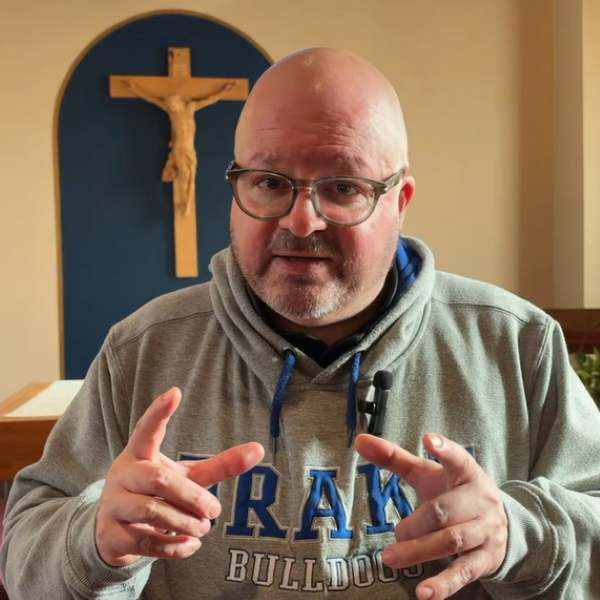
For this edition of our Catholic Fundamentals series, The Catholic Mirror spoke with Fr. PJ McManus, pastor at St. Catherine of Siena Student Center in Des Moines, about the variations on the Eucharistic Prayer said at Mass.
Q: Why did congregations hear a longer Eucharistic Prayer, that listed the names of saints, during the All Saints’ Day Mass?
If you were at Mass on All Saints' Day — and more people were this year because it fell on a Sunday — you very well might have heard a longer Eucharistic Prayer I, or what we traditionally call the Roman Canon. It's the oldest continuously used Eucharistic Prayer in use in the West. The earliest witness that we have to it is from the year 390, when St. Ambrose quotes almost the entire prayer, including naming some of the saints we name today.
The Roman Canon is structured different than a lot of our prayers are. We tend to think of prayers mostly as, “Hi God, I love you, here's what I want, thanks so much, goodbye.” That's not how this prayer operates. It's built as a chiasm. Chiasm is a kind of literary structure. You probably learned it when you were doing poetry in grade school, structured as “A B C B A.” So, you go up, you have a high point in the poem or in the song, and then you recede back. The sides parallel each other.
This is why you get sets of saints on either side of the prayer, before and after the consecration. The first set are, as we would expect, among the most important: the Blessed Mother, St. Joseph, though he's a later addition. Then a list of the apostles, St. Peter and St. Paul, St. Andrew, and so forth.
After we get done with the apostles, we start naming saints that were important in the early church. Initially, the popes that immediately followed St. Peter: St. Linus, St. Cletus, St. Clement, St. Sixtus, St. Cornelius, and then we shift from popes to other important saints and martyrs. St. Cyprian – who was a close associate with St. Cornelius not in Rome, but instead in Carthage in North Africa – St. Cyprian, St. Lawrence, St. Chrysogonus, St. John, and St. Paul; Lawrence was the famous deacon who was grilled on the gridiron; Cosmas and Damian, the holy and unmercenary physicians, the doctor saints who took no money for their care and people that came from all over the empire.
On the other end of the Consecration, we have saints that look backwards. Initially, St. John the Baptist. Then St. Matthias, because he got bumped in the first list in favor of St. Paul. Then we come to women saints: St. Agatha, St. Lucy, St. Agnes, St. Cecilia, St. Felicity, St. Perpetua. These are women from all over the ancient world, some in Rome proper, some in other parts of the Italian Peninsula, and as with St. Felicity and St. Perpetua, all the way over in North Africa.
These brave women saints were willing to die rather than deny Christ. Their memories, along with their bishops and priests, were enshrined in the Church's most important prayer and were said at every single Mass for 1,400 years or more.
So, it's important that on big feast days like All Saints, even today, we continue to hold their names in memory. Not because some random virgin martyr in the second century has had a greater impact than St. Augustine or St. Thomas Aquinas, but because their memory, their willingness to die for the faith was precisely what made the life and contribution of those latter saints possible.
In a certain way, this prayer is a kind of song of the living, which includes even those who have already died in Christ.
Q: Why do we have different Eucharistic Prayers?
Eucharistic prayers are clearly in use by the beginning of the second century. Justin Martyr talks about them like everybody knows what they are: They're the prayer that the president or the celebrant of the Eucharist says.
During the period that we would think of now as the consecration, when the Lord's words are repeated over the elements, how many Eucharistic prayers are there? That's a longer, harder question because we're members of the Latin Rite of the Roman Church. There are a ton of Eucharistic prayers in other churches. The principal distinction that happened early on was the Eucharistic prayer itself, that looks slightly different in the East and in the West, and here's what I mean.
The prayer includes everything from "The Lord be with you," "Lift up your hearts," "Let us give thanks to the Lord our God," up until the great amen. And the reason that's important is because that part right before the "Holy" is called the preface. It's like the preface to the Eucharistic prayer, just like a preface to a book would be the front matter of the book.
In the Latin rite, we had just one Eucharistic prayer, but with a whole bunch of variable prefaces. In the Eastern rites, their prefaces are always fixed; they're always the same. You always use the same preface with the rest of the prayer, which means that they had to develop more prayers for different seasons, occasions, and times of year. And so, as a result, the structure is identical, but the number varies a lot
The reason the Roman Canon is heard so seldom, though, for us is because Eucharistic Prayer II was newly composed after Vatican II. It's a kind of imitation of what people thought was the oldest Eucharistic prayer that we had. It's often attributed to St. Hippolytus, who was the first anti-pope, which is a longer story. But it comes from a document called the Apostolic Constitutions, and in the 1950s and ‘60s, pretty much everybody thought that this had been written by Hippolytus, who died around the year 250. Practically, no one thinks that now. It's a later text, and it's also not really a prayer. It's like an outline of how you would compose a prayer, which means that the reason a lot of older priests got used to using it was not a good reason. In practice, people favor it because it's shorter. It's about half the size of the Roman Canon.
Eucharistic Prayer III is probably the next most often used. It is about 65% the length of the canon, and Eucharistic Prayer IV, which might even be used less than the canon, is probably 80-85% percent of the same length.
The saints, if you say them all, only add about a minute to the whole thing on either side — thirty seconds on one side and thirty seconds on another. But because the saints are the most memorable part of the prayer, because there's so many of them, it immediately signals people we're in for the long one.
Q: How do priests choose which Eucharistic Prayer to use?
I probably do this differently than others. I'm happy to own that. I think what most do nowadays is they default to one Eucharistic Prayer on weekdays and another on Sunday, and they might pull out Eucharistic Prayer I on a big feast day or a feast of one of the saints whose names are already built in. I think the ones for Reconciliation and various needs have spaces for you to add other saints. It could be the saint of the day or the saint of the church that you're in.
What is omitted from Eucharistic Prayer III that's in Eucharistic Prayer I?
It's not so much omitted as reorganized.
Eucharistic Prayer III is constructed around its outline, which comes from an Egyptian or Coptic original prayer, and it's very structured and fairly logical. One of the big problems that we had when the scholars who did all this work went to do this was that in the Roman Canon. There's no explicit epiclesis, which is the prayer that calls down the Holy Spirit on the gifts. The reason that matters is because the understanding which came about very early on in the Latin West was that the change in the elements, what we now call transubstantiation was affected at the words of institution. So, the priest would say, 'Take this, all of you, and eat of it, for this is my body,' and then immediately he genuflects to signify Jesus is here now.
In the East, that change is typically understood to occur at the epiclesis, at the calling down of the Holy Spirit. The reason this matters is because in all the ancient Eastern prayers, the epiclesis happens after the words of institution, rather than before. And so, it created this kind of disjunct, and a lot of blood and ink has been spilled on when the moment is. The reason that it mattered when we were writing the new prayers was, we couldn't have the epiclesis happen after the consecration in our prayers, otherwise it would be like Jesus was showing up twice. So, they had to be moved to the front end. Then they changed some of the gestures that the priest makes during Eucharistic Prayer I to make it look more like what happens with the other prayers, so it's less obviously different.