Catholic Fundamentals: What is the Rosary?
by Benjamin Shane Evans | October 20, 2026
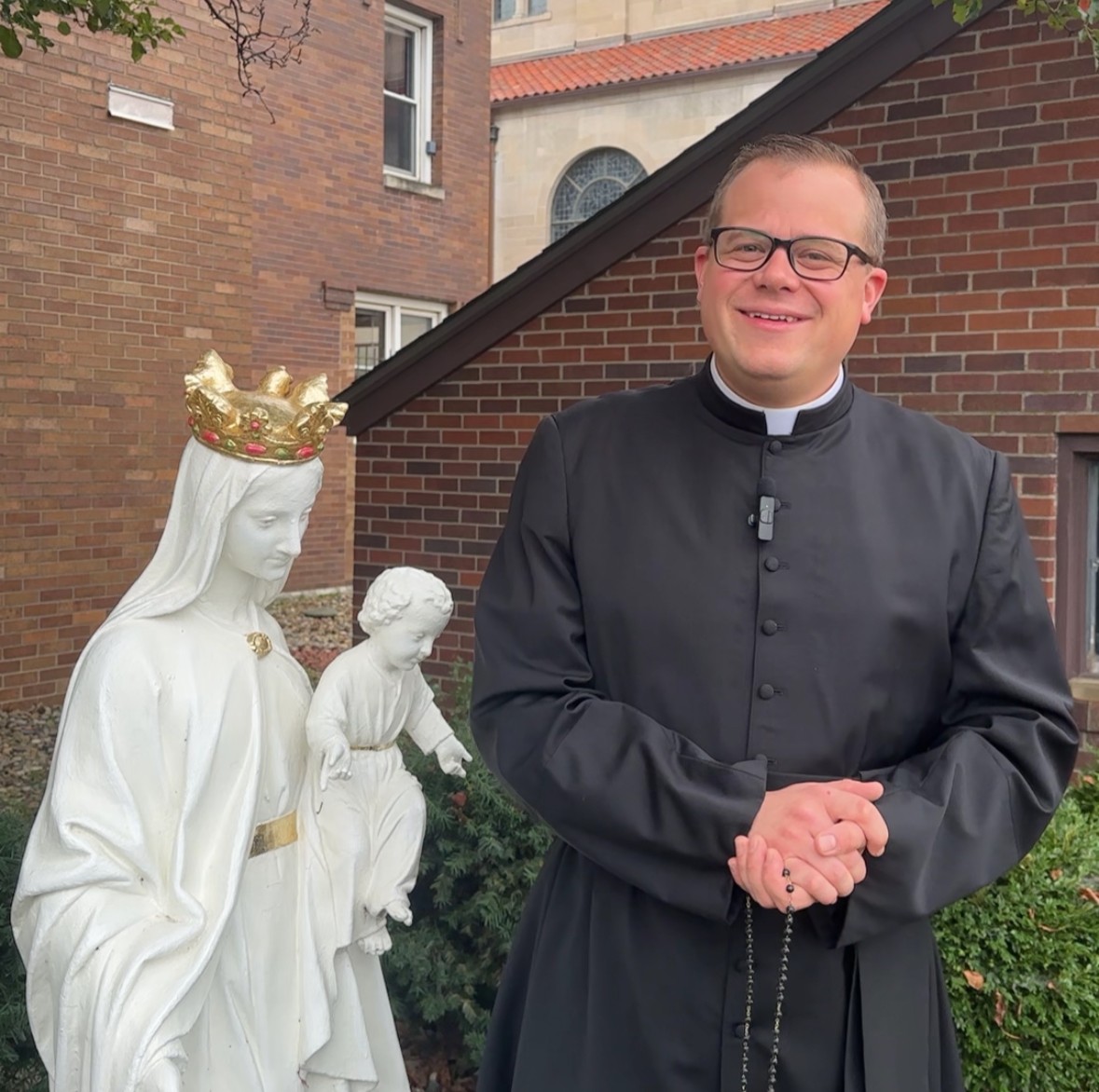
For the first installment in our Catholic Fundamentals series, The Catholic Mirror interviewed Fr. Trevor Chicoine at the Basilica of St. John in Des Moines to ask foundational questions about the Rosary.
Q: What is the Rosary?
Fr. Chicoine: The Rosary comes to us from the earliest days of the Church. In the third century, monks in the desert of Egypt started reflecting on the life of Christ by praying the Psalms, all 150 Psalms, every day. And as history developed, this became a pattern of meditative prayer. Initially, the Rosary was offered for the illiterate monk, the monk who couldn't read or write, as a way of meditating upon different scenes in the life of Christ to more deeply understand who Jesus is, and come through the intercession of our Lady to know Christ's presence in our lives, and to meditate on the great mystery of the Incarnation — that is to say, the mystery of God becoming man, God walking among us, suffering for us, and dying for us.
Of course, tradition has it that the beads as we know them now were given by Our Lady to Saint Dominic in the 1500s or so, and it was really the Dominicans who spread the Rosary throughout the world and encouraged, initially, before Pope John Paul II added the Luminous Mysteries, this reflection on three central mysteries in the life of Christ: his birth, his suffering, and his glory. And if you think about it, if this grew out of a recitation of the Psalms, right, 150 Psalms, if you have three sets of five mysteries with Ten Hail Marys each. It's one Hail Mary for each Psalm. The idea being that this was a way for those who couldn't pray the full Salter every day to enter into a reflection upon who Jesus is, who God is, what He's done for us, and how He moves and works in our life. How grace penetrates us through the suffering, the resurrection, the incarnation of Jesus.
This is the original way of Catholic meditation. This how we pray. How how we come to know the Lord. How, in quiet, in silence, in simplicity, we meet Jesus, Jesus who was born for us, Jesus who suffered for us, Jesus who rose in glory for us. This how we reflect on His life and come to know His life more fully.
Q: Why pray The Rosary?
Fr. Chicoine: My earliest memories of prayer were getting in the car with Mom and my sisters, and the first five to ten minutes of a drive, and we lived out in the country, so everything was a long drive. We had to pray a decade of the Rosary, not a full mystery, just a decade. And Mom would make us go round the car on each Hail Mary, and we'd have to say an intention. And the intention couldn't be for ourselves; it had to be either for somebody else that was hurting in our life, or something that the family needed. That was my earliest memory of prayer, and for us as a family, that was a real moment to come together and to ask Our Lady, ask the Lord, to give us something that we needed, or something that somebody we love needed.
You know, it's funny. When I went off to college, I had a professor of sorts who basically told me this was kid's prayer, and that I needed to find like a more mature way to meditate. And so, to be honest, there were some years in college where I dropped my daily rosary, and it really wasn't until as a priest I encountered suffering in the lives of my people, suffering the type of which I couldn't fix, deep hurting, deep brokenness, and I didn't know really what to pray for or how to pray. So I picked this back up, and for me, this is the prayer I say it every day when I don't know what to say.
This gives me something to say. St. Jose Maria Escriva has a great line about the Rosary. He's the founder of Opus Dei. He says, "May the monotony of the Hail Marys take away the monotony of our sins." As we enter this rhythm of prayer, this rhythm, we don't have to think about it. That's the whole point: you don't have to think about it. You're not making this up as you go. As we enter into this repetitive prayer, "Our Father, ten Hail Marys, Our Father, ten Hail Marys."
The distractions fall away, and in some sense we're able to speak with our heart, with words that aren't even ours. We're able to speak with our heart, asking our mother to pray for us, to pray for those things we can't even voice, that we don't have words, we don't have words to say, but only longings of the soul and of the heart that only she can mend or fix or give us the grace that is needed.
Q: How do I pray the Rosary?
Fr. Chicoine: If the Rosary is new, first you can find so many instructions online. So many there are apps for this literally on your phone. So don't be afraid to those. There's a couple others that'll lead you through this.
The basic structure is this: you start on the cross with the recitation of the Creed. Then, if you notice the structure of this thing, see how we've got beads close and beads far. These are our Father beads, principally. So the far beads are the Lord's Prayer, the Our Father. We say Our Father most. The close beads are the Hail Mary. What I would recommend doing is finding, and again, the resources out there are so many. Find a resource that'll walk you through the various mysteries. You've got the Glorious Mysteries. You've got the Joyful Mysteries, which tell us about Jesus' birth. You've got the Luminous Mysteries, the newest set from John Paul II, which tell us about Jesus' ministry and his life. The Sorrowful, which tell us about his passion and death, and the Glorious, which tell us about his resurrection. The idea is that through these, we're reflecting on the whole life and ministry of our Lord. Now, find find a resource that tells you when to do what and in what order they come.
If you're gonna start, start here. Most most rosaries have some sort of a medallion. This one's got a little little dirt from Fatima in it. Start here. That's in Our Father. Each of these little close ones is a Hail Mary. So it's Our Father, Hail Mary, etc. to the end, and then a Glory Be, and then it's again Our Father, new mystery, new reflection on the life of Christ. What I tend to do in my own prayer, as I start each mystery, I think of somebody in my life. Who I ought to be praying for, principally somebody who's either hurting, especially if it's my fat mouth that's hurt them. I'll offer this, and then that I tend to do that the first half or so of the Rosary. The back two mysteries are always for me. I always offer them for something positive in my life, either for the parish, something that I think we need around the parish, or for somebody who might be discerning, for a couple preparing for marriage, one of our seminarians who's off in formation.
But that's the basic pattern. You've got an Our Father, ten Hail Marys, Glory Be. You can add the There's it's called the Fatima prayer. Look it up if you want. It's optional. The big thing with this, this a devotion. This not sacred liturgy. This a devotion. So while the Church gives us a form for it, it's not a rigid form. So if you figure out how this works for you, that is fine. You don't have to. You don't need to feel like you're locked in on anything. And different people will approach this different ways. They'll end it different ways. They'll include different intercessions from different saints. That's fine. This meant to help you reflect and to meditate. And I know some people get real fretted about the rosary. They get real worried if they're doing it wrong. Ah, ah. The idea is that you're praying through her to him. And as long as this helping you do that, it's working. It's when we get.
Too wrapped up in the mechanics, too worried that I might be doing it wrong. That's when we need to hit reset. But as long as this is leading you to her and to him, it's working.
Q: If while I'm praying the rosary, I encounter something, what should I do?
Fr. Chicoine: So often, when we're in prayer, the thoughts and distractions are actually really important. People get worried a lot about distractions in prayer. We should minimize them, but the thoughts that hit us in prayer are often important, and they're exactly what we ought to be thinking about. If there's particularly a movement of the heart, if we feel called to something, if we feel like we need to repent from something, sign me up.
That's exactly where we ought to pause, right? And really spend some time and ask the Lord if there's not a deeper call there to conversion. The whole Christian life is supposed to be, from birth to death, a greater conformity to the life of Christ. And Our Lady, as the first and greatest disciple, so often is the one who calls us to better, and who prompts in our hearts a desire to live as her Son lived. So if, if in that repetition. In that beautiful, almost monotonous, if you feel your heart touched, don't be afraid to go there and to kind of poke at that and see what it is that our Lord is trying to tell you. What is it that she might be prompting in you — growth, conversion, change, courage? If she's the one who first said, "Fiat. Let it be done unto me according to Thy word," if she's prompting you to your own fiat in this prayer.
Don't be afraid to respond, because so often it's in the quiet, in the simple, in the ordinary, in the everyday that the Lord calls us. Saint Paul's pretty unique. Most of us don't get thrown off a horse and have our eyes blinded and get shoved into whatever we need to do next. No, she moves quietly, subtly, through simple invitations, and if we just have the courage to listen and respond, might do ourselves, the world, the church, a bit of good.