Childhood Letter from Bishop Sheen Becomes Relic
by Benjamin Shane Evans | November 3, 2026
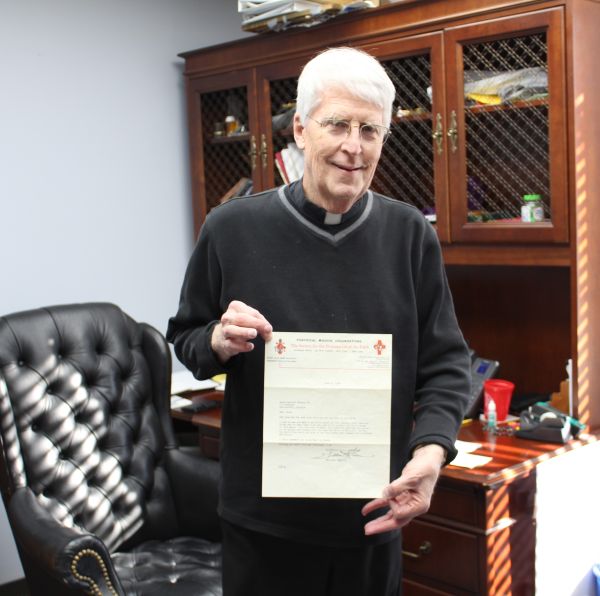
Sometimes, we hold onto things that we do not yet understand the significance of, but something tells us to not let go. For Father Ray McHenry, a retired priest and temporary Parochial Administrator of Holy Trinity parish in Des Moines, it was a letter signed by Blessed Bishop Fulton J. Sheen that he received when he was very young.
“I’m a bit of a packrat,” Fr. McHenry said. “But the letter just seemed special.”
McHenry’s letter was once simply a sentimental keepsake. Now, after Blessed Bishop Sheen’s beatification, the letter is a relic.
Bishop Sheen was declared venerable in 2012 and was officially beatified on September 24, 2026, in St. Louis, Missouri. Bishop Sheen was born on May 8, 1895, in El Paso, Illinois, and died on December 9, 1979, in New York City. He was ordained a priest for the Diocese of Peoria in 1919, earned a doctorate from the Catholic University of Louvain in Belgium. From 1951-1966, he served as the auxiliary bishop of New York and served as the Bishop of Rochester from 1966-1969.
From 1930-1950, Bishop Sheen hosted the radio program “The Catholic Hour,” and from 1952-1957, he hosted the Emmy-winning television show “Life is Worth Living,” which drew millions of weekly viewers.
Fr. McHenry was one of those viewers and remembered gathering around a small set to watch the program.
“[My family] bought our first TV so we could watch Fulton Sheen,” Fr. McHenry said. “He was the highest-rated program on TV. That’s hard to believe that today.”
When the retired pastor was living with his family in Springfield, Illinois, around late 1959 to early 1960, he donated to Bishop Sheen’s missions work through the Propagation of the Faith. In response, Bishop Sheen sent a signed letter thanking McHenry for the donation.
McHenry kept the letter through his life and, over multiple moves, stored it among personal belongings. After Sheen’s beatification, he realized that it was more significant than a memento from childhood.
“I’m thankful I was a packrat,” Fr. McHenry said facetiously.
What kind of relic is the letter?
The traditional three-tier classifications of relics stem from long-standing Catholic practice and catechesis and are generally defined by their level of proximity to a holy person or to Jesus Christ.
First-class relics are defined as the physical bodily remains of a saint, such as bone fragments, hair, tissue, or blood. This category also includes instruments directly associated with Christ’s life and Passion, such as fragments of the True Cross, the Holy Nails, or the Holy Shroud.
Second-class relics are an object or personal possession that a saint frequently used, wore, or owned during their lifetime. This could include items such as a habit, vestments, a personal Bible, a rosary, or a daily tool. It also includes an item created, written, or signed by him, like a letter.
Third-class relics are any religious object, like a piece of cloth, medal, or prayer card, that has been physically touched to a first- or second-class relic or directly touched by the saint during their lifetime.
In this case, Fr. McHenry’s letter signed by Blessed Bishop Sheen may be considered a second-class relic, because it originated from his office, was written and signed by him.
“It’s not like we’re thinking of somebody who was a Roman martyr, five thousand years ago, someone five hundred years ago,” Fr. McHenry said. “There are people who knew [Sheen], and millions watched him. So, to see the effect he had on people and their faith development, and now to see him eventually be canonized, it’s pretty incredible.”