CL's "The Dignity of Work" Panel
by Diocese of Des Moines | June 14, 2026
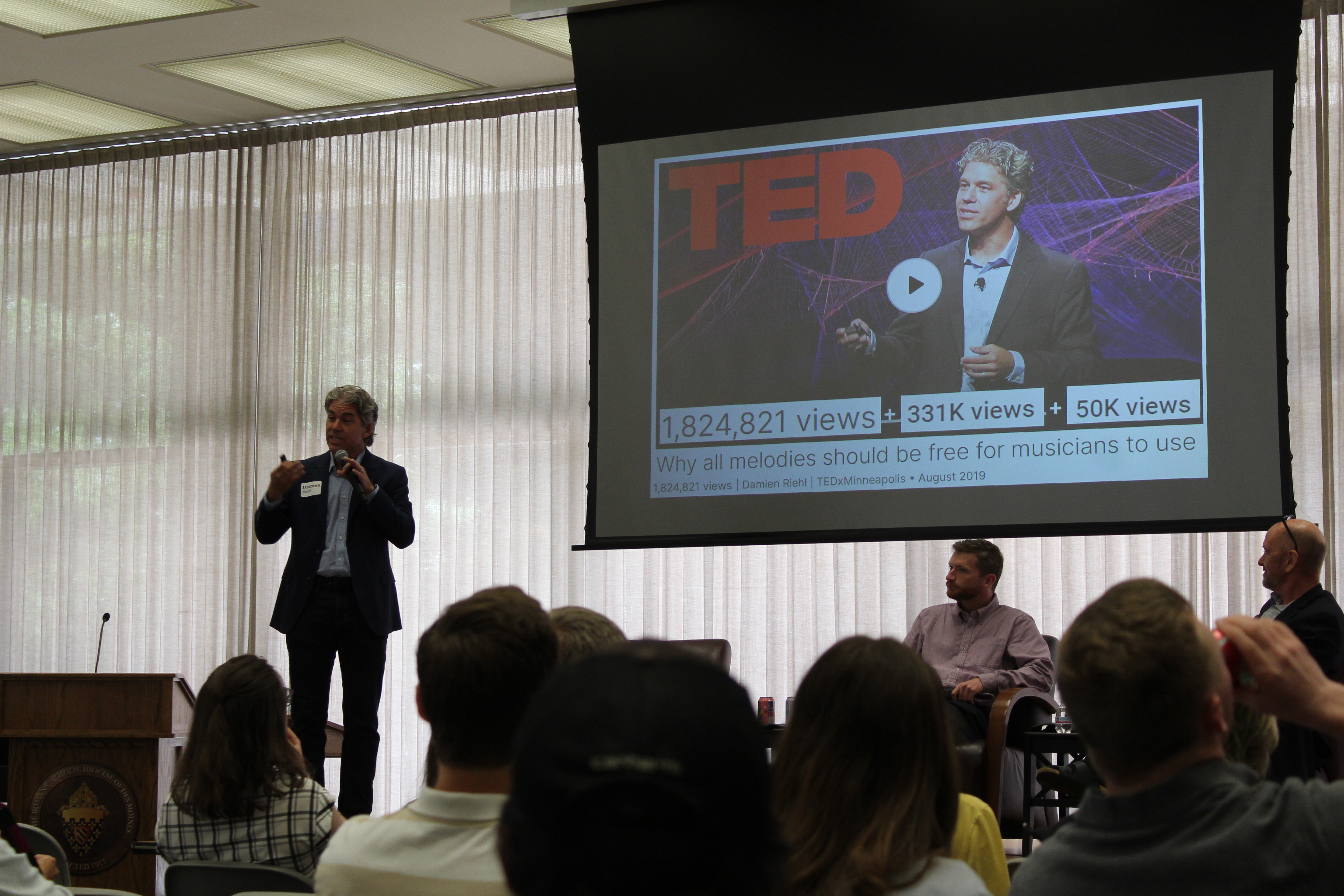
In light of Pope Leo XIV's Encyclical Letter Magnifica Humanita, The Catholic Mirror wishes to share a written transcript from a panel of experts called "The Dignity of Work." This panel was offered during Communion and Liberation's The Des Moines Meeting on Saturday, June 6.
The panel examined the meaning of work amid AI’s rapid proliferation This discussion was moderated by executive director of the Serva Fidem Foundation Nathan Beacom and featured Creighton University professor of business ethics and society Andy Gustafson as well as Damien Riehl, a technology lawyer with experience clerking for state and federal judges and using generative AI in the professional environment.
Panel Discussion Transcript: The Dignity of Work
Event Co-organizer Max Brown: Welcome to our next panel, addressing the dignity of the human being in a rapidly digitizing world. I am pleased to introduce to you Nathan Beacom. Nathan is a force for community building here in the Des Moines area. He founded the Lyceum Movement, which is a space for building better public conversations, and he is the executive director of Serva Fidem, if you heard about last panel, a ministry for high school students. Nathan is a contributing author to The Dispatch, where he just last week authored an article responding to Pope Leo’s recent encyclical addressing artificial intelligence and the imperative to never lose sight of the human face. We gratefully welcome Nathan.
Nathan is joined by panelists Damien Real and Andrew Gustafson. Damien is a lawyer, a leading legal thinker and speaker on artificial intelligence, especially as applied to law. Des Moines is fortunate to have Damien with us today as his work on AI thought leadership takes him around the world, including the Vatican. He’s a talented musician and founder of an online virtual choir. Damien lives in St. Paul with his wife and his children.
Andrew Gustafson is a professor of business ethics and society at Creighton University. Andrew is especially interested in how businesses can contribute to the common good. He teaches classes on business, faith, and the common good as well as Big Data ethics. He directs the Economy of Communion project as well as lives in Omaha with his wife and children. We’re very fortunate to welcome you all here and to hear your thoughts on this very important and timely topic.
Damien Real (DR): These are exciting times for humanity. I think these are exciting and terrifying times for humanity. I just was introduced to a word called “anxiety-ment,” where people are terrified and excited at the same time. And I think that’s maybe a decent place to be able to think through what we’re doing.
My bona fides, most importantly, I’ve known Curtis and Rachel since 1994. I’ve been a lawyer since 2002. I clerked for chief judges of the state and federal district courts. I litigated for about fifteen years. I worked for Best Buy. I did most of their commercial litigation. I also worked for victims of Bernie Madoff. I also helped sue JPMorgan over the mortgage-backed security crisis, so I did high-stakes litigation against the company. I’ve also been a coder since ‘85, so this is me in 1985.
Law plus technology is something I’ve always done. In 2015, I pitched Thomson Reuters. I said here’s legal technology that I think can change the world. You should build it and hire me, and they were dumb enough to do that. I led a team of about 100 programmers and 50 lawyers building this really big thing for Tom Stivers. I left that cool job to do another cool job in cybersecurity. The biggest thing I did there is that Facebook hired me and my company to investigate Cambridge Analytica. I spent a year of my life on Facebook’s campus. I was on Facebook’s campus 57 weeks in a row and trying to figure out how bad guys use Facebook data and the idea.
So I was on Facebook for 57 weeks in a row. At the end of a 14-hour workday, I wrote music with my buddy. I said, “Do you want to brute force 471 billion melodies? Every melody that’s ever been and ever can be, copyright them?” He said, “Hell yeah, let’s do that.” So we’ve copyrighted 471 billion melodies and then put it into the public domain. And this guy says that I rock. And my buddy says Elon Musk has horrible, horrible judgment in all areas including this one.
I’ve been on CBS Sunday Morning. You guys are old enough that you know what CBS Sunday Morning is. The Atlantic did a thing on us, and I was able to meet Jensen. He won the Nobel Prize a few months after this happened. He’s one of the people for forty years who’ve been building AI. The Financial Times made me one of six innovators on AI. This in two weeks, I’m going to be accepting a second award from The Financial Times on my work with rule of law, and I speak a lot to federal judges, state judges. I just was at the Vatican in November. And the idea of the Vatican is that we’ve everybody says we need to align AI with human values. And the idea is like we’ve had human values for about two thousand years. And they’re locked up behind the Vatican. How about we scan all of the archives and then put all that digital into the AI? So that AI can adjust to some of our human values? And it turns out that’s kind of what’s going on right now.
They’re right now taking very careful scans of the books at the Vatican and then putting all the data into a format that we are now, with my team, parsing the data. And then the AIs will be able to ingest it in a way that will bring some of the human values from the Vatican into AI to make AIs. So here I am talking with you. When we think about what AI is, what matters less than the fact that we’ve gone a remarkable way in only three years. In December ‘22, GPT three beat about ten percent of humans on the bar exam, and GPT four beat ninety percent of humans on the bar exam. That’s remarkable. It beat 90 percent of humans on the bar exam. And it didn’t stop there. It just kept going, and now it beats one hundred percent on the bar exam, and soon it’s just going to blow by even the best of us lawyers. This is Gemini, ChatGPT, Claude — they’re all just acing the bar exam.
And we humans aren’t going to get much better. And when you look at Grok, Grok not only aced the bar exam, but it’s 50 cents per million tokens. A token is about two-thirds of a word. And we think about how much we as humans think in a given year. We think about 10 million tokens per year. So that is about $5 per year. Remarkably cheap and remarkably smart. When you talk about human performance in twenty three, AI beat us already in reading comprehension, language predictive reasoning. The lawyerly things. And GPT two was the level of a preschooler, elementary schooler, high schooler beats PhDs in physics. And the question is where is each of us in this timeline? And how soon before AI just blows past even the best of us? And this is human PhDs in their field. And you can see that it used to be really bad.
And then it beat us at March of 2025. It just blew past even PhDs in their field. And it used to be fifty dollars per million tokens, now it’s fifty cents per million tokens. So the intelligence has gone dramatically up while the cost goes dramatically down. And you can understand why this is such terrifying times for everybody. When you think about the dumbest person the left and the smartest person the right. You have to say, where is AI right now? And AI is now at about 135 IQ. It’s about top two percent, ninety eight percent smarter than ninety eight percent of humans. And that used to be true, but it’s actually not true anymore because now the number is more like 137. So now it’s about ninety nine percent of humans that it’s smarter.
When you think about how much work there is going to be for humanity to do going forward what’s left, you might ask? And how much of this is just going to get eaten by AI?
This guy thinks that maybe we should use AI to help people that can’t afford legal help. The 92 percent of legal needs that are unmet because we lawyers are too expensive. So maybe we can actually use AI to do some good, to be able to say, ‘Gosh, people that can’t afford lawyers feel left behind. Maybe they don’t have to be left behind anymore.’ And so that could be something good that we’re doing. And what we think we should probably align that AI with human values. We should maybe do some of that with what the Vatican has been having as part of its human values for the last many years.
So when you think about the AI that we have today, it was built by the grossest parts of the internet. It’s built with cesspools like Twitter and Reddit. And even though it was built with those cesspools, it’s still beaten ninety percent of humans on the bar exam. But the thing is, it missed certain parts of the law. But what if you had a values-based AI? What if the AI baked into it was all of the law, not just the laws of governmental laws, but also the faith laws. And what if it had ethics baked in? What if you could be able to have essentially ethical and moral by design? And this guy says we need to align AI with human values.
Responses: We’ve had alignment with human values for about 2000 years. Eight hundred years of that is the law since the Magna Carta. That’s human values. And of course, we’ve had religious law for the last two thousand years. So if we want to align AI with human values, maybe we should align with the human values that we’ve already baked into our laws, whether they be governmental or religious. The question is whose laws do we align with? A buddy of mine works for a cloud company whose name I am not going to say. Her job for this is to pull down objectionable material.
And so she said, for example, Nazi material under German law has to come down. It’s unlawful Nazi material. But under Texas law, it has to stay up as free speech. So she says, whose laws do I follow? Whose human values do I follow? Do I follow German human values or Texas human values? Because I can’t follow both. That’s the difficulty with getting AI to align with human values is that there are very different human values as reflected in the laws. And of course both of those might not be reflected with Catholic values, or maybe Jewish values, or maybe Sharia law values. So the question is, whose human values do we align with? And what if you could align with most of the human values?
My day job is parsing and running AI across one hundred and ten countries worldwide, their cases, their statutes, their regulations. And my day job is parsing running AI across all of those. So I can do a fifty state survey or a one country survey to be able to ask any question and be able to get a legal answer in about five minutes from the one hundred ten countries. And I can do that, by the way, you can too if you like. So think about this access to justice. How good would it be if you could ask any legal question and not have to ask a lawyer? But just get the information?
What if you could do that for the fifty states and the European Union and Catholic social teaching? Wouldn’t that be great to be able to have that available to each of us in this room? Also available to every business person in the country to be ethical by design. What if you could be aligned with most of the countries, most populations, and most of the faith traditions?
We talk about agents. You may have heard about AI agents, and they’re going to go out and do work in the world. If you say to an agent, “Hey, go ahead and start a business,” create a business plan, create an LLC, create a bunch of products and a bunch of ads, create a bank account and if you have any questions, let me know. Think about all the bad things that can happen. There’s lots of laws that will be broken. Lots of faith laws that will be broken. But what if you could instead say, “Hey, before you take each of these actions, agent, consult the legal world. Consult the laws of the United States. Consult the laws of Iowa, of the United States, of the European Union, of Catholic social teaching. And if anything you’re about to do is going to violate that? Let a human know. So the human can give the thumbs up or thumbs down.”
I think this is the way that we can be legal and ethical by design, having the agents be able to follow the law, whether they be governmental law or faith tradition laws. A friend of mine has a we’ll get to this in a bit. Maybe we can have this in a way that we can have AI help our faith. That stream AI is a way that they’re adjusting all capital social teaching. So if you want to be able to be guided in your faith.
This magic AI can help you in your faith, and maybe our faith can help AI. That is, if Google and Anthropic and OpenAI ingest our faith, then maybe we could have the AIs be more ethical and more moral.
In November when I was in Rome, while at the Builders AI Forum, we had Catholic leaders and the AI builders, and we said that we need to give AI a moral compass because this is coming down the pike. And there were rumors at that point that the Pope would eventually actually give an encyclical, which of course he just did a couple weeks ago. He said to us when we were there, “you know, we should preserve the dignity of the person and the common good and have moral discernment in the world.”
And that is of course now that was in November 2025. That was repeated with this encyclical. And if we want to align AI with kingdom values, we’ve had that for a bunch of years. We talked to Rome about how we could be able to maybe take some of that from the archives, scan them, open it up, put it in the public domain and let AI learn from it.
So this is the goal. Longbeard is the name of the company that’s behind Magisterium AI. They’re doing this work and they’re going to open source some of the Vatican documents so that we can ingest them, so the AIs can learn from them. I am also working with the Catholic Digital Commons. That’s a 502(c)(3) nonprofit based out in Texas. We are building lots of things. There is a board including a venture capitalist from Microsoft, Father John Barrozzio, my favorite vibe coding priest from Rome whose name. Father John LaRocca was on the board. There’s an ecclesiastical board, and I’m on the technical advisory board.
Yesterday morning, I was in Boston giving a talk at the about my music thing, and Father John happened to be there at the same time. So this Father John; he leads up the Catholic Digital Commons. And while we were there, we were talking about how we could be able to have maybe the United States Conference of Bishops and be able to say maybe you can be able to take a lot of the data that is currently copyrighted and maybe license it to the Catholic Digital Commons, so we can more broadly distribute the word. That is, this can maybe be 21st century evangelism to be able to have people who are using AI get some of those human values into their AIs. That just happened yesterday morning in Boston. We are collecting data that is data from the Vatican, data from the College of Catholic Bishops. They’re also building tools to be able to work with that data. And so it comes from all over the place.
We’re building what’s also called the Catholic Semantic Canon. And the Catholic Semantic Canon is everything that matters to our faith. That is, it’s building upon a legal data standard that I built called Folio. And the legal data standard’s being used by the largest law firms in the world, largest legal tech companies like Microsoft is using it in-house, Intel’s using it in-house. The biggest law firms and the biggest legal tech companies here are using much of them. All of these companies here are coalescing around SALI and Folio. And they’re collecting things like breach of contract, murder, theft. Each of those is a tag that each of these companies is tagging with their data. So they can say, ‘Show me all the murders in Iowa in 2025.’ Each of those is a tag that you can quickly pull data from. This is not just in the US; it’s worldwide. So we have people in India, UK, and Asia et cetera. So when you think about it in the law: murder, theft, trial. These are all important to the law. And it turns out that murder, theft, and trial are also in the Bible. Do not kill. Do not steal. So there is an overlap between legal values and faith values. And so what I did is I took my folio legal data set, and there are eighteen thousand tags, everything that matters to law as donated by everybody. You just saw on that thing. So 18,000 tags, I essentially copied that and made it as part of the Catholic semantic net.
To be able to say ‘murder’ depends on trial, and about fourteen thousand other things are also being used by our church. We’re tagging these things up. We’re going to classify everything from all of the documents. So I am going to go down and I am going to show you actually live what the Catholic Digital Canon is because it’s quite remarkable. Is that we are doing things like you can see an actor is a deity who is the triune God? Which is God the Son, also known as Jesus. And so you can see here that this is a definition of Jesus. He’s also known as Logos, also known as the eternal Son and the Messiah and the only begotten Son. And here are examples of Jesus Christ being used in a hearing. And we do the same thing for the Holy Spirit, but we also do that for human actors, for clergy, clergy et cetera. And we also do that for what authority are you using? Are you using governmental authority? Or using religious authority? Under which levels of magisterial authority is this? Is this a defining teaching or theological opinions?
Then we have normative concepts. Are you authorized to do things? Are you prohibited from doing things? Do you have a right to do things or are these violations? Then ethical concepts like people should have justice, integrity, dignity, beneficence. You can imagine going through and we had 14,000 things. Like what are the types of sins that matter? What are moral sins? What are personal sins, et cetera?
So we’re tagging up everything that matters. Once we’re tagging up everything that matters, like God the Father, God the Son, the baptism mark of Lord, the transfiguration, Marian devotions, Reconciliation, human dignity, justice, solidarity. Then you can tag those things up from the documents. Once you tag up all those things from the documents.
You could say, “Let’s go through the Bible and tag these things up. Not just this version of the Bible, but go back to the Greek.” And let’s also do that for the papal documents, the bishops’ documents, diocesan documents, and your local newsletter. Once you tag them, you’ll be able to pull them. Even if something mentions “the Son of God,” “Son of Man,” “King of Kings,” they’ll all resolve to the item that is Jesus. And then once you do that, you can have the AI use those technical documents in a way that is more easily understood by the AI. This is a way you can put ethical values from the Vatican and from your [parishes] into being able to do this. We are now along the way to be able to do this all for free and open source, zero dollars. I am a volunteer, so is Father John here. The idea is that we shouldn’t be making money on something that is our faith. And we should be giving these things away because we need more people to be believing in our future.
Because this is talking about work, everyone’s worried about scarcity. Are we all going to get fired? On my worst days, I think of AI kind of as a tsunami that each of us can run in front of for a little bit, but eventually the tsunami is just going to come crash all over us. That’s my worst case. In my best case, I think we’re maybe going toward abundance. We’re going to have more work than we ever have been, and people are going to be busier than ever not in spite of AI, but because of AI. This is something called Parkinson’s Law: you don’t know the word, but you know the concept. If you give yourself a month, it’s going to take a month; and then Parkinson’s Law: if you give yourself two weeks, it’s going to take two weeks. This is the idea that work will expand or contract based on how much time you have.
That’s kind of where we are with AI. That is something called Jevons paradox. Jevons paradox is we thought LED light bulbs were going to save us a lot of energy, but they’re so cheap, we just leave them on all the time. It’s too cheap to meter. So what if Jevons paradox with AI? You say, gosh, every time I want to call my lawyer it costs me a thousand bucks. Ah forget it. I’m just going to risk it. What if a thousand bucks shrinks down to fifty bucks? Man, I’m going to call that lawyer every day. Maybe in the aggregate you spend more than a thousand bucks, And maybe that lawyer is going to be way busier than they ever have been. Not in spite of the AI, but because of the AI. The Jevons paradox: if legal advice were too cheap to measure, maybe we’re going to need more lawyers. And maybe we’re going to need more medical doctors. And maybe we’re going to need more not in spite of the AI, but because of it.
We had amazing AI in the 1980s; it was called Excel expressions. And you know who this freaked out? It’s, all of the accountants that said, this AI is going to take all of our jobs. Because these things on the left used to take a week. Now it does in seconds. Man, our jobs are going to go away. But when the clients figured out, wait, it’s not going to take me a week to get this back, but it’s going to take me a day. Run scenario two. Run scenario ten. Run scenario twenty. Now we have more accounts today than we ever have, not in spite of the AI, but because of the AI because of Jevons paradox. So I think you know, between scarcity and abundance, I think we’re going to team abundance.
I’ll close by saying that I’m a coder. I literally on my way from the Twin Cities, I was speaking into my phone and then while I was speaking, the bots were actually building code, software. And I was doing that not just for one project but actually five projects. So as I was driving, something that would have just been me thinking with my thoughts doing regular human things, I was actually building five sets of software as I was driving down Interstate 35 on the way here.
I’m busier than I’ve ever been. Not in spite of the AI, but because of the AI. And all of my coding friends are like, ‘Hey, I’m working 18 hours a day because I’m keeping all my bots fed. I’m making sure that they’re busy doing all this cool work that I wasn’t able to do in the past.’ Jevon’s paradox. So if we do it right, I want to leave with two ideas. Idea number one is that AI ethical by design is maybe a hopeful future that we should all shoot for. We should have the AIs ingest the Catholic social teaching and ingest all of the human values and all of the laws, so they can be lawful at any time. And number two is maybe we won’t have scarcity. Maybe we’re going to be team abundance. Maybe we’re going to be busier than ever, not in spite of AI, but because of AI. Because Jevon’s paradox is going to make us more fruitful and maybe helpful with human flourishing. With that, I’m going to pass it on.
Andrew Gustafson (AG): I’m Andy Gustafson. I grew up on a hog, corn, and cattle farm in the middle of Nebraska. I’m really glad to be with you here today. So thank you so much. Is it working? Just got to keep. I know, I have to keep. So thanks for having me here. I’m from Creighton University. I’ve been there for 21 years and I do teach classes on AI and social media and meaning of life at our business school. Actually, I’m not going to talk about that very much today. I’m going to talk more about dignity and work.
But I really like the things that you finished with there, Naomi. I think it’s before we had Gen Zs up here and they were saying, ‘What faith is facing the unknown.’ At least in faith of the unknown, that’s where we’re all at. There is a lot of fear right now about AI among people because it’s just unknown. We don’t know if it will lead to abundance? Will it lead to scarcity? We’re not sure yet. But as people of faith, I think it’s so important for us to be ready for either way. If everything goes to hell in a handbasket, who better than us to help everyone? And if things get better, let’s figure out how to use it for the good as much as we can instead of gaining the same. So I think that’s the attitude we want to have. We want to have an attitude of faith, not an attitude of fear in the midst of it.
I’ve got a lot of students that aren’t getting as many job offers as they used to get, so there is a concern especially for those on the cusp of it. But I think in business we’re already seeing there’s some pullback. The honeymoon phase is over. We’re figuring out how.
Use it wisely and maybe what are stupid ways to use it. I think that’s changed. It’s already starting to change. This is not just yay, no matter what with our eyes shut, but what works here and what doesn’t work. I think we’re going to be in a good place.
I’m going to talk about this. This is right out in front of my house that I left this morning. Giving internet dignity in an economy of communion. I’m very involved with the economy of communion, and I’ll share more about that. These are three of my workers that help me with my projects. There in Omaha. Pope Francis met with some of the Economy of Communion (EoC) members. I got to go to that in 2017.
He said, “If you, the EoC, see the entrepreneur as an agent of communion by introducing into the economy, the good seed of communion, you become a profound change in the way of seeing and living business.” The EoC was a movement that started in 1991, 35 years ago, and it’s part of the Focolare Movement. The Focolare Movement, as I am learning about Communion and Liberation is very similar. There are a lot of commonalities I think between the way of thinking about things. But giving, unity, sharing — that’s what the Focolare Movement is all about. And the EoC was started down in Sao Paulo, Brazil, to help the poor have jobs. It was started by Focolare who wanted to start companies to help those people have dignity and work and also to make money that they could give to charity. So it’s free market and communal — this is what I love about it.
You’ve got the individualism of free market on the left, which I’m a fan of free market, but at the same time it’s got the communal concern, the common good concern of socialists. And so you bring those two things together. I’m a private entrepreneur working in a free market and I’m choosing to leverage what God’s given to me in a way that can make a real impact in the world. I have students sometimes who come to me and say, ‘I love business but I really am afraid I’m going to lose my soul if I go that way.’ So they think they’re going to go into social work. And they say, ‘Go into business, make a lot of money and you can fund five social workers, and you can also change business while you are doing them.’ I always encourage my students: if you want to go do ministry, do it by going into business. You can do lots of ministry through business. Next, this is my example: communion properties in Omaha, Nebraska are responsible for ninety five toilets. That’s how I think about it because if a tenant rents from me, that toilet is not their problem; that’s my problem. And so I’ve got to take care of that; that’s my responsibility. We fix up buildings, we rent them out, we build relationships with lots of workers with our workers and the community all over the place.
The first place I ever bought was the Triplex. I knew it was a drug house before I bought it. I didn’t know what a dogfight was, I didn’t ring in the basement because I didn’t know what a dogfight ring was. It was very close to Creighton and I could walk to school and all of our properties. When I walked from my home to my office, it’s about a mile and a half. I walk by ten or twelve of them, depending on which route I go. This is a great place. But if somebody came, they wanted to rent my apartment and they were like, can we rent the upstairs? They said we can’t get our piano up there.
I said, “What am I going to do?” They said, “That’s not my problem.” And so I bought another house. This one was a six-flat. I wasn’t married yet, and so I was living there by myself. And then I got some more guys. Eventually had seven guys living there. So when I got married, my wife said, “I’m not living and cleaning up six other bachelors’ stuff.” It was very unreasonable to me to buy another place and move out of that one. But then I’d meet with my guys on the front porch regularly. These were some of the guys that worked for me. Some of them were semi-homeless or homeless, issues of different sorts, and some of them were just guys that needed work. And so all of them would come and we’d sit on the porch and talk through things. Now we do more things through text, but I still meet with them. They come to my house to get their money. And my son, who’s three and a half years old, prays for them every night when he gets through the prayer. He gets to a point, he’s like, okay, I am going to take this over, and then he goes call their names and prays for all of them. So they’re good friends of ours. Some of them even babysit for us. We’ve got a couple women that babysit for us that are part of this group next. So the crew along the way, they’re not all with us. Some of them have passed away, but I’ll tell you a couple stories in a minute.
Next, how do we do business differently? I have difficult buildings. So over time, God gets you into something for one reason, and then you stay with it for other reasons. You marry the guy when he’s twenty because he’s so handsome and even when he’s sixty-five, and he’s got a beer belly, and he’s got bad knees, you still love him but even more, right? But not quite for the same reasons you did when he was twenty. But for different reasons because now you have five kids and you have twenty grandchildren. This is the person you live life with. You get into something for one reason, and then you stay with it for others. I just wanted to fix up old houses, and I love that. And I love redeeming them or preserving them and not just gutting them and putting in granite countertops and stainless steel washers and dryers, but actually preserving them, making them look beautiful the way they used to be. And so that was what attracted me to them. But I started to realize that I am kind of imitating God in a way of creating and redemption. Other buildings, some of the buildings we bought. Other people thought we should tear down.
And we thought, no, this has value. And that’s the way God is with us. He sees value where other people don’t see that value and puts faith and hope and love in those things. And that’s what we did with the building.
But then I started to find all these homeless guys around me that wanted to work, and so I started to find things they could do to help me with along the way. So people that were considered by others to be unemployable, and in some respects they are, but I employ them and keep on giving them employment. They began to be my close friends, and I’ll tell you a couple of stories.
Tenants. I didn’t even think about tenants when I first bought my first house, but I found that, Oh, I had tenants who fall on hard times and they lose their job. We had one woman that’s lost her job four times in the last five to ten years. And every time we just said, don’t worry, you’ll catch up. We’ll just let you stay there. We’re not going to kick you out. We don’t want you to be homeless. And so we keep them and help them. We’ve rented to people that are sex offenders, to people that are coming out of prison that have a very difficult time. So we have a lot of different people that we found that we can help and I didn’t know that when I got into it. That was something God showed me and revealed to me over time as I was walking forward in faith.
Reciprocity is really a key thing for folks. We give and sometimes we get back and sometimes we don’t. Sometimes we get stabbed in the back, but we just keep on giving and trust that faith is going to bring back good things more often than not. Very relational, not just transition, not just transactional. A lot of times I am talking to someone that might be a tenant, and they say, “What’s the process? What are my credit scores have to be?” And I say, “We don’t do that.”
Most of what’s happening in our evaluations happen right now as I look you in the eye and feel like can we have a relationship that’s trusting or not or what’s going on here?
This is a great quote from Pope Francis: “a forming communion beyond charity.” So I don’t give that much to charity, but I also get about 30 percent less of what normal people do for rentals. So I just cut out the charity middleman and rent our stuff out for about what I need to pay the mortgage. Sorry, NGOs, but that’s just what they do. Capitalism knows philanthropy in our communion. It’s simple to get part of the profits without embracing and touching the people who receive those crumbs. In the logic of the Gospel, if one does not give all of himself, he never gets enough of himself. So I think this is a real question. All of us need to think about it. We were raised: if you go to business school, you learn profit maximization. Then you are going to give a lot to the church and give a lot to faith and give a lot to charities, which want to make as much as you can. And I found that I’d rather just make enough. What’s profit sustainability? What’s enough for me to have, and why do I need more than that? I might make a lot more, but then what am I going to do with that if you use it for the glory of God and for His kingdom? How can I use what I have really for others instead of just for me? We know what a social contract is. We know that from Catholic teaching. So it’s not ours anymore. You said earlier everything was given to you and you have that responsibility. I feel that too. What you said earlier Robert, thank you.
Eliminating many forms of poverty through business activity. We often think of poverty as money, but I don’t think that’s the most important poverty. We do help with that poverty with the guys that work for us and people that work for us. There is also a poverty of community. I know people that live in the park and drink all day. They don’t really have community. They have people they drink with, but they don’t really have community. They need a community; they needed someone to be around them. They’re human beings; they need others to be there with them and be for them. And so, one thing that we are able to give help people in poverty now. There’s a lot of billionaires that are poor in community. That’s not something that’s financial. There’s a lot of people around here that are poor in community, and they need that community. That’s what we’re here to offer.
Work poverty. I like some people think work is a curse. I know the Bible talks about it as a curse, but I think work is actually something we all want. We want tasks, we want to accomplish things, we want to have something we’re proud of, and so we need work. We need tasks given to us, and that’s part of where our identity comes from too. So if we don’t have identity, we don’t have work a lot of times. When you lose your job, you feel a sense of loss of identity. And so we need identity from our work. Also, if you don’t have a job, you don’t have any identity, you don’t have any money. You start to wonder why am I here? There might be an existential problem. Just a general sense of well I don’t know why I am even here. Some of my guys that are sixty years old alcoholics are saying I don’t know what I am leaving behind.
So we all have those desires. What am I doing with my life? And ultimately, spiritual problems. And I found that when I’ve helped guys with these different ones down the line, the spiritual poverty that starts to be transformed too. They start to feel enriched in certain sorts of ways. They start to feel like God really is watching out for me because other things are falling in line.
Next business as a spiritual practice: We often think about what does a church have to say about how I should do business, but there is this other side of it that has become more obvious to me. As I’ve gone more and more in this direction, it’s that my business practices themselves start to be part of my spiritual activity. In my encounters I have with others in business, I am actually able to see, like, where is Jesus in this person? How can I be Jesus to this person?
The other day, I was trying to read the Pope’s encyclical, and I was almost at the very end sitting on my porch, and one of my guys came up Jeff. Talk to Jeffrey. There are twenty minutes left before I have to be home for supper, but Jeff wanted to talk, and so I was like, ‘God, you are bringing me Jeff. I am going to set this down and I am going to listen to Jeff.’ And that’s what I did.
So there is all kinds of encounters. We have like that on a daily basis. What do you decide to do? How do you decide to be present for that person that God brings into your life right now instead of just like get the stuff done next one, please. This is just one example. I bought this at the six box. It had been abandoned for three years, had six bathrooms in it. All the toilets were full, even though they had not had plumbing here because there were twenty homeless people living in this house. And so when we got there the first day, I had three or four of my guys with me and I could have said, ‘Hey make sure you get those toilets out.’ But I didn’t say that. I said, ‘I know what you’re thinking. We’ve got six toilets in there, full of you know what? And it’s drying, and it’s very gross. And guess what? I’m going to take them all out! You guys don’t get to do it.’ They’re like, ‘Oh cool!’
One way for me, the guy who is employing them, to take responsibility for that and give them a special sort of dignity. And that kind of attitude towards my guys over the years has really bred a lot of loyalty and a lot of friendship. And we had much more than just a work relationship. I don’t even call them my employees. Some of the guys we’d come inside and sit around the table if it was too cold outside.
Next one: “Kindred gift in love.” The consumer economy based on culture of having, the economy of communion is an economy of giving. And this is a quote from John Wendell, one of the first EoC entrepreneurs I ever met: “Joy, this is a gift that EoC gives. The happiness, well-being, and deep satisfaction that comes from living a meaningful life integrated with our most heartfelt beliefs results from the relationship that grows out of this giving and receiving.”
I have this picture of this woman because when I see someone smiling and running, I think what is wrong? That’s because I’m not in shape. I have been in shape before and I’ve run. And I do smile, and the reason I don’t smile now is because I am not in shape. It’s not because that’s crazy; it’s because that’s healthy.
I had a person one time when I was talking about EoC, and they said, ‘What’s the motivation?’
And I said, ‘Actually, if you are properly functioning, you will find joy in giving to others.’ As human beings, we actually have a God-given desire to love other people and give to them. We really do. But if you haven’t utilized that very well, you don’t find joy in that. You’re not functioning properly. That’s on you. That’s not because it’s a weird thing to do, it’s because you’re weird. Even though you might be very common, you might be normal, but like that’s why most people are okay.
Next one. This is Izzy. Izzy was living in that red truck behind one of the houses I bought when I first got going. And he said, ‘can I live in this? Keep living in my truck until you rent the place out?’ And I said, ‘yeah, but it’s November in Nebraska. Why don’t you live in the house? We have plumbing going and heat. Can you do stuff?’ He said, ‘Oh sure. I can do this and that.’ It has worked for me for 17 years.
At the end, he was on hospice care in our living room for a couple of weeks before he finally passed away. And he became a very dear friend of ours. He used to call me his big brother, even though he’s twenty years older than me, and I called him my crazy uncle, even though he’s Puerto Rican and I am Swedish. But we got along very well because he’s a dear friend of mine. One of the most important things that God has given to me through my business is this: who cares about the money? This guy and having that relationship and building relationships. That’s what’s really been meaningful. And that’s been the gift God’s given me through what I’ve been able to do by living it out. This sort of communion mindset.
Next, Pope Francis again: “The first gift of the entrepreneur is our own person. Your money, although important, is too little. Money does not save if it’s not accompanied by the gift of the person. Messiness wounds a communion, so we have a lot of messy people that we deal with. And if you’re helping messy people, you’re going to get stuck. That’s just the way it goes. But with business practices, we often have policies and procedures to help us maintain an arms distance from people. So we don’t let their personal problems become our problems. And so I’ve got credit scores to make sure you are not going to be a problem for me because if you don’t pay me, then I don’t have the money to pay who I need to pay. But Luigi Bruni, the Italian economist said, “If you open yourself to the wounds, then you can open yourself with the blessings.”
If you don’t let yourself be wounded, you’ll never get blessed. So we’ve had so many cases where we open ourselves to the possible wounding, renting the guys who are coming right out of jail. We don’t know what’s going to happen. And then they turn out to be good, to be great. And they do that blessing of having given faith to someone and then seeing them flourish. We’ve got some times where we help somebody and then they want more help. We help them out some more and they turn around stab us in the back. It happens, but more often than not it doesn’t.
The divided life, we know what the divided life is. I won’t stop on this one very long. Instead of having a separated life where your work life is one thing, and your personal and faith life is another, how do we bring those together? That’s really what the church wants us to do. And bringing those two things together so living an integrated life is so important. You see that entrepreneurs are agents of communion by introducing into the economy, a sense of communion. You begin to become profound change in the way of living and seeing business. So again that goes back to the first quote.
Two kids that are not here with me today. Thanks a lot for having me and I look forward to our discussion and talking more about AI.
Nathan Beacom (NB): Thank you both for those contributions. What I’m going to try to do is weave these together a little bit and maybe allow time for a couple of questions. Has anybody read the new encyclical? These numbers, anybody read about the new encyclical? Has anybody read an AI summary of the new encyclical? We got a few honest AI readers out there. How many people have heard of Rerum Novarum? This is in this audience is pretty high number.
Rerum Novarum was written due to this economic situation in which the dynamic of work changed pretty drastically. You went from modes of production that were happening in people’s houses, the kind of household economy oftentimes where husband and wife and kids are all making some butter to take to the market, to a factory where somebody owns all the capital and everybody else is on a wage, and they’re being squeezed for every bit of their labor. And this was a big problem: Is this a dignified way for people to live? And what does the Church have to say to that?
And so, the beginning of the Encyclical is the Pope saying, ‘Why does the church have something to add here in this discussion of people in Silicon Valley or computer programmers?’ They are ‘This religious organization, like I think I remember going to church with my dad when I was little. Okay, but it’s okay if you don’t go. Yeah, but I think I remember going to church when I was a kid. But what does that have to do with what we’re doing in Silicon Valley?’
The answer is that the Church is an expert in humanity. Two thousand years of history of what humanity is. One of the things that I want to highlight from the encyclicals, Pope Leo said that we have a duty to remain profoundly human as things change. You have a duty, a personal duty to remain profoundly human. And I think that dovetails with Communion and Liberation, if you know there is maybe one like or should know, which is ‘vive de intensamente el real.’
So this is what he says is the precondition for an encounter with God: that an individual lives intensely reality. And so, as we’re encountering artificial intelligence and spending things that will get us maybe more to our screens or will separate us from the material of our work, how do we remain profoundly human? How do we live intensely the real? Because only by doing that. And I think, what you mentioned is having somebody in hospice in your living room is an intense form of living the real. So how do we not separate ourselves from suffering from reality? That’s one theme I just want to point out from encyclical. Another is how are the benefits and deficits of this technology, this AI technology being distributed around the world? And how do we try to distribute.
And I thought it was interesting that the Pope has a lot of criticism, maybe for the way that some of the big global companies operate. But at the same time, he says in this encyclical that entrepreneurship is a vocation. And that’s a pretty profound thing. Vocation is a high word to get to that. It’s not just a money-grabbing enterprise; it doesn’t have to be. But by that same token, one of his big concerns is if this technology is owned by a small group of people, and all the profits come back to that small group of people, and we might say, ‘Well, this will allow us to distribute universal basic income to the third world like that,’ he’s not very happy with that answer because what we want is for those people to have dignified work where they can put their creativity into the process of creating something new. They’re not only the end result but also the means through which we create value. We should look at creativity as an essential part of the process, not just the outcome.
And so, however we’re developing AI, it should be in a way that takes into account that we want everybody globally, and as much as is possible, to have the opportunity to develop their humanity through work. This is something I got from Catholic Studies at the University of St. Thomas. Sorry to my rivals here at our St. John’s grad Tommies and Johnny’s traditionally known. They should get along, but cats and dogs can live together. We move sports conferences so it’s all simpatico. But one of the things they had a big program in some of these questions of like Catholic ethics and business.
One of the things I learned was, in the Hebrew Genesis, is this distinction between work and toil? So there is actually work in the Garden already which is. Kind of caring for the Garden, Adam is doing a work by naming all the things of creation, putting kind of a human imprint on creation. And the curse is that work becomes toil, not that we have work. And so there’s an encyclical by Pope John Paul II which I would encourage you to read called Labor Exercens, The Exercise of Labor, where he talks about some of that: what is the true vocational quality of work? How why is it good? For us, and what are things that make it toil? And what are things that make it work. And so these are some themes that Leo, hopefully Leo gets on too. Which is that for it to be work, if you’re bringing AI into your legal work or into your office, is it allowing you to maintain creativity and your own kind of agency in the way that you’re doing the work or not? So is the person being reduced to another cog in a machine? A bigger machine, or does the person kind of remain the pilot?
There used to be a sign, this thing that’s gone around in IBM in the 70s. Also, if you don’t know this, this is just a fun Iowa pride fact. The microchip on which all of this depends was invented by Robert Noyce who’s an Iowan. He invented Intel Corporation so shout out for better or for worse, maybe you’d be mad at him if you don’t like the things that have happened. But are you just like another transformer? What’s going on inside the computer? Is it just a bunch of transistors that are charged to different levels? And ultimately, is the way we’re implementing that making the worker, the agent, the creative agent in this remaining a tool and not a master? At IBM it said computers. It said on the wall or in the handbook: computers should never make decisions.
Because computers can’t be held responsible. And that’s what the Pope is emphasizing: we need to maintain responsibility in our work. When it comes to moral decisions or political decisions, and especially decisions in war, we can’t say, “Well, we’ll just feed it into the machine and then we can wash our hands.” Maintaining human privacy and human agency is another big thing.
Q&A
NB: One question that I wanted to ask both of you is: After “Laudato si’” came out, some people are like, “Oh, people still are exploited. It didn’t solve anything. Big surprise.” Pope Leo XIII wasn’t Jesus. We have to wait until the second coming for all the problems to be solved. Probably. What did happen is there were a bunch of labor unions and cooperatives and apostolates and things that would go minister to the poor and new ideas about how to organize business and work. I am curious if you have thoughts about are there? What are ways Catholics can respond? There is obviously a lot of unknowns, but to the new dynamics, what are some particularly Catholic ways that workers or businesses could respond?
DR: If you think back to the late 1800s, early 1900s, we thought machines are going to take all of our jobs. Almost all of us are farmers. And all of a sudden, we have these tractors that can do the work of a hundred humans, a hundred men. And what are we going to do for work? We’re all going to be out of jobs. But of course, we went from 90 percent farmer workforce to almost all knowledge work these days. My great-grandfather would look at what I do and he’s like, ‘that’s not a job.’ My dad said there’s two kinds of jobs. He’s a boilermaker so he’d be in 100 degree heat. He said, ‘There are two types of jobs: the jobs where you shower before work or the jobs where you shower afterwards.’
And like the job, my great grandfather wouldn’t think that what I have is a job. Probably wouldn’t think what any of us has a job. So the real question is now, as AI is doing a lot of this menial work, the stuff that we don’t like to do. We as lawyers do a lot of thinking, and we do a lot of thinking. We do a lot of drudgery. And AI is going to do a lot more of the drudgery, letting us do the thinking. But more importantly to what you just said, letting us interact with humans more. Like I spent a lot of my time as baby lawyer researching millions of documents. And doing, spending no time with humans at all. But I think today’s young lawyers are going to be spending more time serving the 92 percent of legal needs that are unmet, actually talking face to face with people.
Is that better or worse? I would say it’s a lot better. So maybe I’ll close to say that there is something called the lump of labor fallacy. The lump of labor fallacy is what the 1900s people thought like there is only so much work to be done, and the tractors are going to take all that work. It turns out it didn’t take all that work. We just made more work to be done. And the lump of labor fallacy truly is a fallacy. There’s more work to be done, and that’s kind of exemplified by the fact that there are five bots right now building five pieces of software that I wouldn’t have built in the past. And I think that we, as an economy, are just going to keep building more and more. And I think that we’re going to be more human if we do it right in the process because we’re going to have spent more time on face-to-face meetings like this rather than down in the drudgery, either in the farm or on the drudgery of looking at documents.
AG: I think I tend to agree with your optimism on my good days, especially. We have never seen a place in the past where technology that came on the scene caused there to be less work. It just hasn’t happened overall. But it’s hard to say that to the people who are maybe immediately losing their job or who are in their mid 50s and they’re out of work. So we have to be very cautious, I think. It’s good to be optimistic, but it’s also good to remember, you don’t tell the woman who just lost her son in the war that we’re winning the war. That’s maybe we will win the war, and maybe AI will help us all be much better. But we also want to be very compassionate for those that are struggling and for new kids coming out of college. It’s hard; it’s very nerve wracking for them right now. So just build with those virtues there. And just think about how can you especially minister to those people in your parishes? That’s what I would say.
NB: Thank you for that. I think maybe I’ll just end with a final point because we’re just coming to the end of time here. Which is another quotation that I love from Magnifica. And he says something which what you just mentioned is like, well, can we promote more face time and less maybe screen time or looking down time. That’s kind of an overarching theme of the Encyclical as we enter this kind of new phase in our economic life.
How can we preserve the understanding that the human being is a face and not a function? That’s kind of the primary thing. He said, “The face remains the protagonist of our history; the human face remains the protagonist of our history.”
So how does everything come back to serving the human subjectivity, the human person? And ultimately, it’s because in the face of the other person for the Pope. That’s where we have the possibility of seeing the face of God, the face of Jesus. And it’s actually that human face. This is kind of a remarkable thing that he ended with. But that human face is the thing towards which history is headed — a human likeness. So in whatever it is that this wave of technology is developing — automated art or automated music or automated this or automated that, automated conversation. We have to develop in a way that retains our agency as human beings, retains our relationships, retains our families, and retains the dignity of the human face.
DR: So in economic terms, what is abundant is cheap. What is scarce is expensive. As AI makes all the widgets we make very abundant, therefore very cheap, what will be scarce and therefore expensive is humanity. There are only so many humans, and we only have so much time with our attention.
So as the world gets flooded with AI slop of writing and AI slop of music, we’re still going to want to go to the concert to watch Taylor Swift. And we’ve known that since chess has been able to beat us as humans for decades now. We still go to chess tournaments because of that humanity. Because we want to see humans battle it out, and we want to see humans on stage. And we want to be able to look people in the eye and be able to say, you and I can connect in this way. That is going to be increasingly scarce, therefore increasingly valuable.
So for the young people that say, ‘Gosh, what should I do for a living?’, do something that exercises your humanity because that is going to be scarce, therefore valuable. And coincidentally, that also aligns with Pope Leo: that we need to value our humanity. So I think that our optimistic future of what’s scarce, therefore, humanity is valuable, also aligns with our faith: to be able to say let’s treasure humans in the way that we’re not just widgets, and we’re not just cranking out AI slop, we’re here together and let’s enjoy that.
AG: One other thing, last time I Googled it, it’s 31 percent of middle schoolers’ best friend is a chatbot. So we need to be very careful with your kids and encourage your kids in the right direction. Don’t let your kids be on their electronic pacifier when they’re three years old. Looking at the screen, off you go through the grocery store. Help them become more fully human, and that’s up to all of you to do with your children. Got a one year old and three year old. I am not always sometimes I wonder why did I bring these people into the world right now? But my parents brought me into the world in 1969. I am like why did you do that? Sixty eight happened last year. What are you doing anyway? So just be cautious with your kids really care for them.
NB: And I think on that point, I appreciate hopefulness. I think hopefully I’ll ask for it. And I think about sometimes, you say we’re in these unprecedented times. Pope John Paul II was living under the nuclear threat of the Cold War, versus to get into nuclear war. So these times have been difficult before. Times have always been difficult. As St. Augustine said, “We spend all this time saying, the times are bad, and the times are bad.” He said, “You are the times. If you’re good, the times are good. If you’re bad, the times are bad.” So maybe we can end on that note.