Music, Fasting, and Silence
by Diocese of Des Moines | November 17, 2026
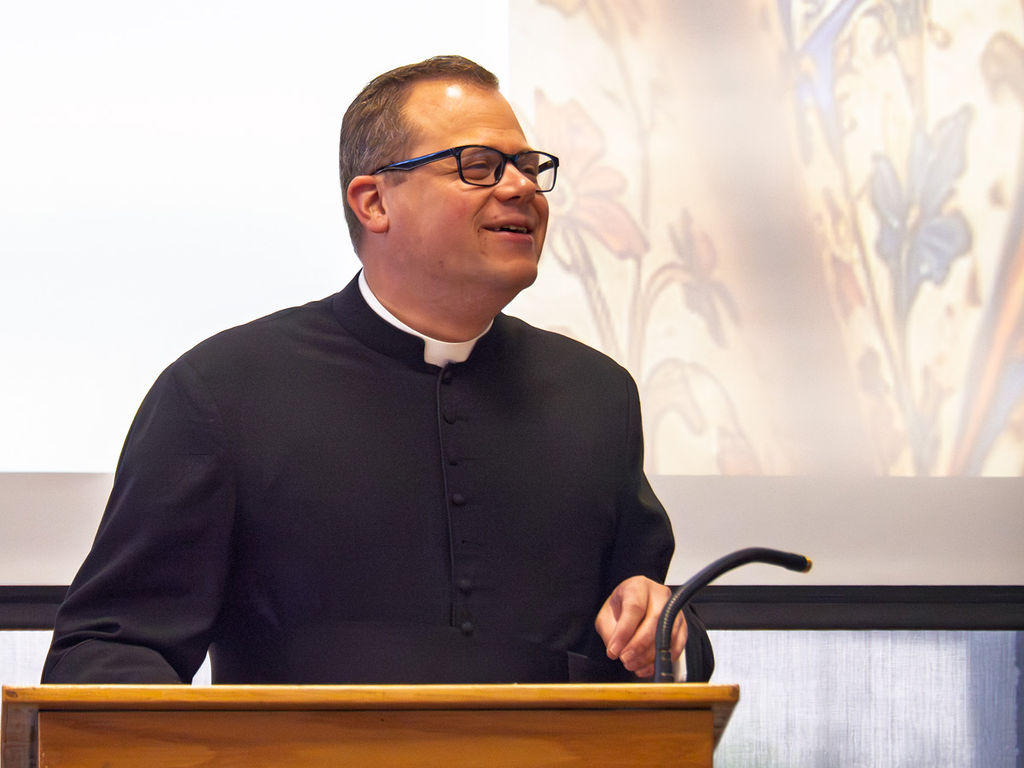
The following is adapted from a lecture given by Fr. Trevor Chicoine, pastor at the Basilica of St. John in Des Moines, at the NACCM's Finding the Voice of Lent workshop held at Sacred Heart parish on Saturday, October 17.
By Fr. Trevor Chicoine
Let us pray:
O Lord God,
I hope by your grace for the pardon
of all my sins
and after life here to gain eternal happiness
because you have promised it
who are infinitely powerful, faithful, kind,
and merciful.
In this hope I intend to live and die.
Amen.
Good to be with you all. I want to start by making a confession and by offering a condition for all that follows: These are the thoughts of a liturgical theologian, not the thoughts of a (your) pastor nor the directions of the Bishop’s Vicar for Worship. Please do not think I’m going to massively apply these thoughts to our life at the Basilica nor am I going to be out there calling balls and strikes. This is literally my theologian’s hat: when I have it on, I’m opining theologically. However, at the end, I will speak to you as a pastor with some suggestions for life and such.
The General Instruction of the Roman Missal (GIRM) offers a few salient thoughts on music. There’s much more found in other liturgical documents both from the Holy See and the bishops' conference, but there is one pesky little paragraph midway through Chapter 5 of the GIRM which is often ignored. Chapter 5 is the chapter that deals with the layout of churches, how things should be arranged, and what should go where. Of all the sections of the GIRM since the first edition of the GIRM for the present missal appeared around 1970, this is the bit that has seen some real modifications over the last decades. For example, this section of the GIRM used to say that the church’s preference was for the tabernacle not to be located in the sanctuary of the church but off in a separate chapel. So strong indeed was the Holy See’s insistence on this point at one time that when St. John’s in Des Moines was raised to the dignity of a Minor Basilica, the Holy See required that the tabernacle be relocated off the high altar because of the directions of this chapter that were in vogue at the time. St. John Paul II, when he released the present edition of the GIRM around 2000, very carefully reviewed this chapter and made some intentional refinements. One of refinements took away that preference for a separate chapel and reordered the options for tabernacle placement, such that the first option listed, which gives it only the slightest level of preference, is to place the sacrament in the sanctuary perhaps on an old altar. None of this is meant to enter into tabernacle wars, and by in large your energy is best spent anywhere else other than arguing with your pastor over where the sacrament ought be reserved, but I offer this as an example to show you how carefully the Church has reflected over this bit of the General Instruction.
Chapter 5 begins with some general observations about church buildings, then treats of the particular appointments of the sanctuary, altar, ambo, and chair before discussing where and how to seat the people, where to put the music, and where to put the reserved sacrament and where to put statues and images. Now, I want to be clear, this section of the GIRM is often among the least followed sections. Did you know that paragraph 311, just before the paragraph we’re going to be looking at together, says that the reservation of seats for private persons is to be, and I quote, “reprobated”? Now, we reserve seats all the time for special events or for this or that reason and provided it doesn’t get out of hand, nobody is up in arms. I offer that simply to show there are multiple little bits of Chapter 5 that we’re not great about following in general, including paragraph 313, which speaks principally about the placement of the organ and other instruments. Let me offer paragraph 313 and make a few comments:
The organ and other lawfully approved musical instruments should be placed in a suitable place so that they can sustain the singing of both the choir and the people and be heard with ease by everybody if they are played alone. It is appropriate that before being put into liturgical use, the organ be blessed according to the rite described in the Roman Ritual.[123]
In Advent the use of the organ and other musical instruments should be marked by a moderation suited to the character of this time of year, without expressing in anticipation the full joy of the Nativity of the Lord.
In Lent the playing of the organ and musical instruments is allowed only in order to support the singing. Exceptions, however, are Lætare Sunday (Fourth Sunday of Lent), Solemnities, and Feasts.
I don’t want to dwell much on the organ itself, except to say two things: the Church has been perennial in her praise and preference for it. I checked the Latin on the GIRM and it’s as clear as the English: the organ and other lawfully approved instruments, not or other lawfully approved instruments. Point made. Moving on.
Let’s look at those last two paragraphs of 313:
In Advent the use of the organ and other musical instruments should be marked by a moderation suited to the character of this time of year, without expressing in anticipation the full joy of the Nativity of the Lord.
In Lent the playing of the organ and musical instruments is allowed only in order to support the singing. Exceptions, however, are Lætare Sunday (Fourth Sunday of Lent), Solemnities, and Feasts.
During the two great penitential seasons (and yes, Advent is a penitential season), several things happen in the sacred liturgy. Flowers are typically removed, extra decorations should be sparse. It’s better to leave the space as bare as possible, especially during Lent. In Advent, there’s a venerable old custom from the Italians which I really wish we could see adopted that moderates both the tendency to rush over Advent to Christmas but also recognizes the great time of hope. In Italy, the Christmas tree is put up on the Feast of the Immaculate Conception, and it is lit on Gaudete Sunday, and decorated Christmas Eve day. This is purely Fr. Trevor’s own opinion, but I think such a progressive entry into the full joy of the Nativity of the Lord is a wonderful custom and may well be a model for planning music in Advent: obviously Immaculate Conception, Gaudalupe, and Gaudete need to be full celebrations with gusto, but I don’t wonder if we couldn’t better hedge our joy towards Christmas itself.
In Lent, the Church calls for a much greater fast, because it is in fact entirely about the fast, the penance which must be done for our sins in order to prepare for the great paschal solemnities. In English, our word “Lent” comes from an old English word that basically meant “spring” and speaks to the time of year in which the great fast occurs. In Latin and basically every other romance language, Lent’s name is literally Fortieth- Quadragesima in Latin. Lent is both incredibly simple but also incredibly difficult. It is the fast. The preparation time in which we shrive our souls to commemorate the passion and resurrection of the Lord. To assist us in our fasting, perhaps even to poke some of us who are slow to fast, the Church imposes certain communal acts of fasting upon our prayer. She takes away the great hymns of praise in her liturgy, the Gloria falls from the Mass, the Te Deum falls from the Office of Readings. She progressively takes beauty away from the eyes of her children: first the flowers and other decorations are stripped from the altars, then, after allowing us a brief reprieve on Latare Sunday, for a merciful mother cannot starve her kids for 40 days straight, after giving us a taste of beauty in both flower and music, she literally by tradition covers the beauty of sacred images, until we gaze only upon the cross’ beauty on that Friday we call Good. She makes us fast, and one of the ways she makes us fast is in our music.
In Lent the playing of the organ and musical instruments is allowed only in order to support the singing. Exceptions, however, are Lætare Sunday (Fourth Sunday of Lent), Solemnities, and Feasts.
What does this look like, fully lived out? It’s actually kind of scary. There are no preludes. No postludes. There is silence. Stark, utter silence. Music accompanies the opening antiphon or hymn, but as soon as that piece is over: Silence. That might mean at Solemn Mass Father is censing the altar in silence. Apply that principal across the Mass: If the Gospel procession lasts longer than the Lenten acclamation with its versicle, there is silence. If offertory and preparation take longer than the hymn, there is silence. If there is no closing hymn, the recessional walks out in silence. At the office, when the Liturgy of the Hours is celebrated publicly, the procession happens in stark, awkward silence. Breaks are given for this, especially St. Joseph’s feast, the Annunciation, but St. Patrick’s Day, unless your parish is named for him, is silent. Across the years some parishes have tried different things during Lent to call to mind the penance. I’ve seen parishes drop the opening hymn. This should be avoided as the entrance chant (or hymn) is particularly a part of Mass and shouldn’t be dropped. Sometimes folks assume different postures during the penitential act, kneeling for example used to be very common, some of you probably remember this. It wasn’t ever called for in the rubrics. Sometimes you’ll find empty Holy Water Fonts, really this is only done for Triduum. What does the Church actually want to do to mark Lent? Force us into the awkward silence, make us quiet so we can hear the spirit call us to repentance. Take away the distraction so we are left with stark reality which must be faced in humility.
Now, it’s hard to do this perfectly and I don’t for one minute want to question anybody’s very sincere attempts to mark Lent, save for really encouraging you not to withdraw the Holy Water, but think about making Lent quiet. Think about taking that rubric that says the instruments fall silent from the Gloria of Holy Thursday until the Gloria of the Vigil seriously. (Acapella Good Friday is really cool, just saying). What might this look like in a parish? How might you take this principal and apply it to your own Lenten practice at home?
I don’t wonder if a great place to start would be this: try to trim back at least the preludes and postludes. Let people sit in silence before and after Mass. I get most of us don’t run out of music on entrance, but a lot of us do at offertory. What if offertory, especially if you’re going to use incense for it, was let go silent when the music was up? Think of this image: incense rises in silent prayer to the throne of the Father. How much grander does that make Easter when Lent is truly quiet?
Why do we need this? I get it: I’m a musician and while it’s been a while, there were years when I worked pretty hard to get a Sunday Mass’ music plan under my fingers at the organ bench. We want to give our best. Most of us who play for Mass I think do this because we fundamentally enjoy it. Why would the Church ask us to be silent?
Is this not because the silence is so deeply needed? Life is loud. Life is chaotic. Life is deeply disturbing. If you’re like me, the thing that typically gets you in trouble is your mouth! So, maybe for Lent, enter the silence with Mother Church. Enter the silence, turn off the radio, back off on YouTube and the sheer white noise that is most of social media. See what he has to say to you. Notice where it is. The heart needs to be called back to faithfulness. Don’t be afraid of what you might find in silence; brokenness is not ugly, it’s just real, sometimes painfully so. But he has given us every possible grace needed in the sacraments to overcome whatever we might find in the silence so we can more perfectly celebration his resurrection.
This is not a Diocesan directive, nor will I be muzzling my own parish musicians for Lent, so don’t be surprised when we’re not perfectly in compliance with GIRM 313 at the Basilica in a few months. But as we head into Advent and Lent, I really do want you to think about your practices of fasting and silence. Fasting is so important. There are very few spiritual practices that I have found which make half the difference in my own life than fasting. Over the years, I have found it curbs a lot of sins, including sins which are hard to break. As you are able, I really invite you to consider your habit of fasting during Advent and Lent. Advent can be especially hard because it the holiday season, and before you decide to be the weirdo at the company Christmas party, remember that first reading we get every year on Ash Wednesday: do not appear to others to be fasting. Eat the darned cookie, drink the egg nog. Don’t be weird.
I also want you to think about silence. When I gave this talk to the young adults of my parish, I realized most of them have come of age in a time when there was no silence at all. People will often ask about my vocation story. It’s rather boring but I was pretty sure of my vocation at a young age. I spent a lot of time in silence, often alone as a lad. Most summer days I would spent either picking raspberries or on an old swing hung off a tree down by the creek on our acreage. It was there, in that silence, I think that the Lord formed my vocation. In 8th grade, I received an iPod. Any of you remember those? These were the ancestor to the iPhone; all they could do was play music that you loaded on to them via a cable you plugged into your computer, typically with songs you loaded off of CDs. I know. Ancient technology. My first iPod had a tiny black and white screen. I’ll be real honest here, friends. My prayer life and my formation in holiness was far better before the Christmas I got my iPod. Now, it didn’t wreck me, and thank God it didn’t have any of the nasty stuff that kids of that age can now access on their cell phones: but it did distract me and break me of the silence. Many of you may never have known silence, never dwelt there for long periods. If you have, kudos. These days, it’s harder and harder to find the silence.
Earlier this year, I made my first good retreat in a couple years. Fr. Michael Amadeo and I went down to Atchison, to the Abbey for a silent retreat in early summer. Yes, tip of the hat to you, Benedictine grads. After the noise and bustles of the last years, after the intensity of this spring with my move and Fr. Aquinas’ sudden demise, the silence was sweet. The Lord was generous and spoke in clear ways that he hadn’t in years. And he gave me a couple particular graces that have carried me through a couple really hard bits in the months since. I need to go back to the silence soon. I suspect you might too. And what I’m inviting you to do is to use the periods of fasting specifically built into our life cycle as Catholics as a chance to not only find the Lord in some quiet and fasting, but also, to find yourself a bit more. Don’t be afraid of what you may discover. Know that he’ll be there waiting.
Let me close with a word of sincere thanks. Thank you for all you do for our local church. Thank you for the ways in which you sacrifice to make your parish’s life of prayer and worship beautiful. We don’t all have the same style or taste, frankly, I think that’s good and shows the strength of the Catholic community in the Diocese. We are united even as we pray in different manners. For the times when you put in the effort, the extra hours and nobody notices-or worse-complains, thank you. For the times when the keys don’t sit right under the fingers, its okay, and thank you still. For the times when it really does come together, and something new and beautiful is born for the goodness of God’s people, God bless you. If I can be of help, don’t hesitate.
Let us Pray:
O Lord God,
I hope by your grace for the pardon
of all my sins
and after life here to gain eternal happiness
because you have promised it
who are infinitely powerful, faithful, kind,
and merciful.
In this hope I intend to live and die.
Amen.
*Photos taken by Shari Naughton, submitted by Julie Curry.