It’s time to get serious
by Diocese of Des Moines | October 20, 2026
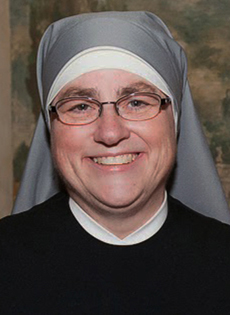
By Sister Constance Veit, lsp
Sister Constance Veit is the communications director for the Little Sisters of the Poor in the United States and an occupational therapist.
As a Little Sister of the Poor, nothing gives me greater joy than making the elderly happy by helping them to rediscover the many reasons to celebrate life.
I love to listen to their stories, to create art, play games and just laugh with them. But lately I feel that it’s time to get serious.
Physician assisted suicide was legalized in three U.S. states this summer – bringing the total to 13 states plus the District of Columbia where this form of killing is allowed.
It was also legalized in France, where the Little Sisters have the greatest number of communities.
As a result, the lives of the elderly, especially those who are most frail and alone, are increasingly under threat.
So, in addition to making the elderly happy, and perhaps of greater urgency, I realize that my first duty is to protect them and defend their dignity.
I think that this unsettling state of affairs is what some call a “kairos moment” – a providential opportunity for decisive action.
In response to the ever-darkening culture of death, we are called to witness in ever-more convincing ways to our conviction that human life has inviolable dignity and worth at every stage, regardless of outward appearances.
Pope Leo has written about compassion and concern for the needs of others, and he has demonstrated these values on many occasions, most recently during his trip to France.
The scenes of him leaning out of the popemobile as it crept along the Champs-Elysées to bless babies and caress a profoundly disabled young girl, and his interactions with the elderly and disabled in Lourdes speak volumes. Videos of these moments are worth watching over and over on YouTube!
In his first encyclical, Magnificent Humanity – whose very title speaks volumes – Pope Leo wrote, “Our relationship with life seems to be in crisis today. Everything that appears as a ‘limit’ – incapacity, illness, old age, suffering, vulnerability – tends to be seen primarily as a defect to be corrected, rather than as a reality through which our humanity matures and opens itself to relationship. And yet we must remember that humanity flourishes not despite limitations, but often through them.”
His words are all the more poignant given Leo’s current illness.
“Finitude, when truly accepted, does not diminish us but opens us to recognizing the face of God and others,” the pope wrote. “Indeed, precisely because we experience limits – vulnerability, suffering and failure – we can recognize the inviolable dignity of every person, both our own and that of others. In this same experience, we remain capable of intuiting a fraternity greater than ourselves.”
A fraternity greater than ourselves – this is what we are called to create and to which we must witness in the midst of the darkness overshadowing our contemporary culture.
Charles Camosy, a professor of moral theology and bioethics at the Catholic University of America, recently published a book entitled Living and Dying Well, a Catholic Plan for Resisting Physician-Assisted Killing.
One of his concrete suggestions on how to resist assisted suicide is to regularly volunteer in a nursing home, especially with those suffering from dementia, because their lives are at the greatest risk.
Such volunteer service “signals publicly the equal human dignity of these populations,” he writes. “The power of such encounters is such that simply being in the space of those who bear the Face of Christ this way can be transformative. You never know what the results of these encounters may be, for the seeds, once planted, take on a life of their own.”
Camosy suggests that we should serve the elderly in “a very public way” so that our light may shine before all.
He writes that “our consumerist throwaway culture finds ways to discard our vulnerable populations quietly, away from the public eye, without public discussion or scrutiny.”
Camosy asserts that we need to make as many people as possible aware of these vulnerable populations and their need of protection. “Declaring to the world that it is a privilege and a joy to encounter and care for these populations is an essential part of what it means to resist our throwaway culture and proclaim the Gospel in our time.”
With nearly 40 years of experience as a Little Sister of the Poor, I believe that my life attests to the undeniable dignity of the elderly.
My teenage encounters with them were, for me, thoroughly transformative, planting seeds in my heart which grew into a religious vocation and a life of the greatest joy and fulfillment.