Labor of love gently restores focal point of historic church
by Diocese of Des Moines | February 23, 2026
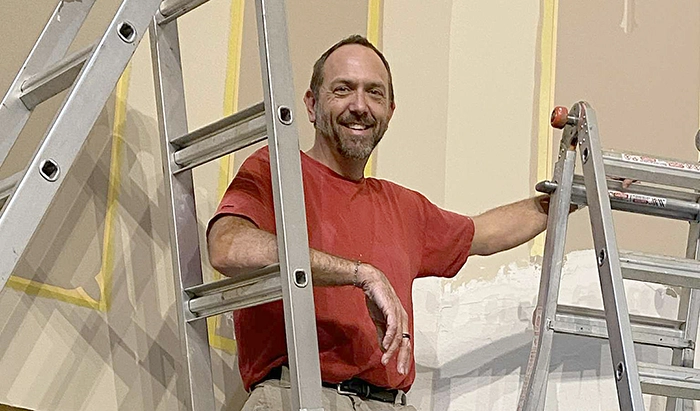
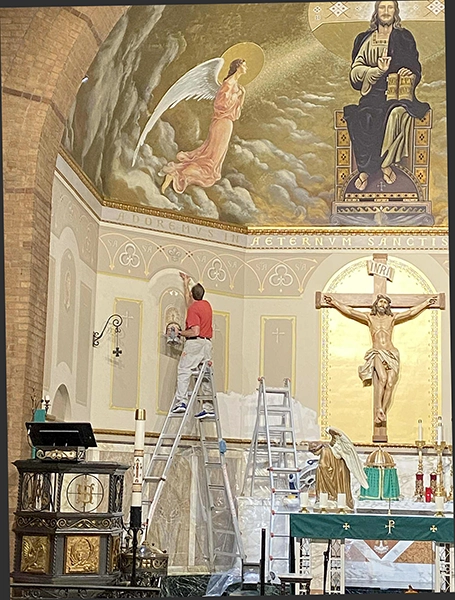
Restoration artist Zack Bunkers meticulously works on the lower part of the mural in the apse of St. Anthony Church in Des Moines. He arrived every afternoon at about 3:30 p.m. and left at about 8:30 p.m., setting up the ladders and scaffolding and taking it down before he left so parishioners could still have Mass each morning.
By Jennifer Willems
After more than 20 years of lifting the gaze and hearts of people in prayer, the mural in the apse of St. Anthony Church in Des Moines required a closer look of a different kind.
With candle soot and exposure to the elements taking their toll of the lovely lower mural behind the crucifix, the paint and plaster also had started to peel. The gold leaf stenciling was losing its luster, as well, and Father Michael Amadeo, pastor, knew it was time to take action.
“When people come in, this is what they first see,” he said. “I think by caring for our churches, maintaining the beauty of our churches, it exemplifies the importance of what is happening in that space.”
The parishioners agreed and with the help of some generous donors, Father Amadeo was able to undertake the restoration. The work was done by Zack Bunkers, a Des Moines native who has also left his artistic mark on St. Augustin Church and Our Lady of the Americas Church and been responsible for restoration at the State Capitol.
In fact, Bunkers would come to St. Anthony after a full day at the State Capitol. Father Amadeo said the artist would arrive at about 3:30 or 4 p.m., setting up the ladders and scaffolding, and work in the church until 8:30 or 9 p.m., taking everything down before he left. That way, even though parishioners had to sacrifice the 6:30 p.m. Mass on Tuesday, Wednesday and Thursday, they were still able to have the 8:30 a.m. each day.
“So it’s been a great labor of love on his part to not only do the project, but allow us to have daily Mass,” Father Amadeo said of Bunkers.
Safeguarding against water damage
Since moisture was getting in from the exterior, tuck pointing was needed on the wall behind the lower part of the mural, and it was necessary to correctly divert the rainwater in the gutters, Father Amadeo said. He explained because this had not been done, the water was coming off the roof and going down the wall.
To repair this, workers had to take out the plaster in one section and there was some exposed brick for a time.
The $15,000 raised by parishioners took care of the cost of all the work, without having to use insurance, according to Father Amadeo.
He said the upper part of the mural, which depicts Jesus being attended by two angels, would require some “touching up” in a year or so. More funds will be needed for this.
“They are appreciative that we are addressing the damage,” Father Amadeo said. “They are very impressed with the gold that is behind the crucifix. Again, it’s striking and it literally kind of illuminates the cross.”
“Meticulous work” by a steady hand
As he watched Bunkers navigate the ladders and scaffolding to restore the stenciling, Father Amadeo had nothing but praise for the man who was seemingly defying gravity.
“It’s very meticulous work, because the stenciling lines are extremely narrow, and we’re probably dealing with six different shades,” he said. “To be able to match them and then to paint them has been very meticulous. And yet, the painter’s hand, the motions of what he’s painting, are graceful.”
Bunkers has worked in some capacity at the State Capitol since 1999 and took over the renovation there in 2009. He is the “third generation” of restoration painters since the work began in the late 1970s.
“I like the detail,” he said. “My degree at Iowa State was in medical illustration, so I was going to illustrate medical books. That requires very, very, very fine detail.”
Preferring not to sit at a desk and draw all day, however, he opted for traveling the world and climbing on buildings. Restoration work also appealed to the archeologist in him.
“You dig back through the layers and layers of paint, find the original design and colors, and replicate it and bring it back to its original glory,” Bunkers said.
Father Amadeo appreciates that attention to detail and how that contributes to what happens when people come together to worship God.
“We’ve gone through periods in the church where space is grander. We’ve also gone through periods of the church where space has been very simple, almost barren, if you will. Both ends of the spectrum have had their place,” he said.
“But I do think at the heart of it, our art, whether it be simpler or grander, really does speak about the significance of what has happened in that space,” Father Amadeo said. “Therefore, it is important to maintain these spaces.”